Importers are the lifeblood of export sales—but finding them manually across dozens of countries is slow, expensive, and unreliable. An AI tool to find importers changes the equation by analyzing business data, matching companies to your Ideal Customer Profile, and surfacing verified procurement contacts at scale.
Whether you export textiles, chemicals, pharmaceuticals, food products, engineering goods, plastics, steel, packaging, or industrial machinery, AI-powered importer discovery helps you move beyond outdated directories and generic contact lists toward qualified prospects who actually source products like yours.
This guide explains how AI importer-finding tools work, what to look for when evaluating platforms, and how exporters use them to build predictable international sales pipelines in 2026.
For broader context, read our pillar guide on AI lead generation software for exporters and our complete overview of how exporters find overseas buyers. Foundation guides: ICP identification and AI ICP generators explained.
What Is an AI Tool to Find Importers?
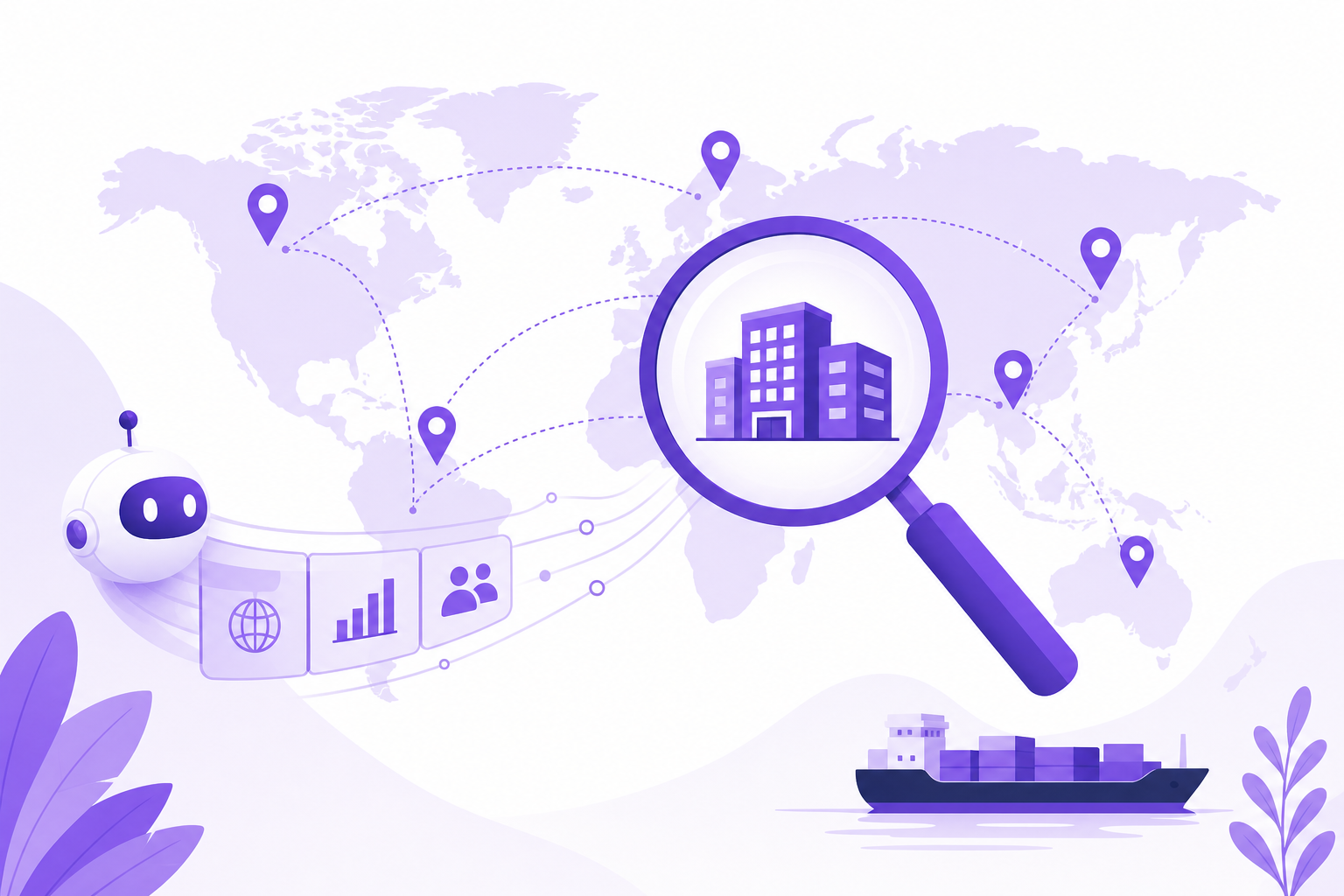
An AI importer-finding tool uses machine learning and business intelligence to identify companies that import, distribute, or wholesale products in your category—and rank them by fit with your Ideal Customer Profile.
Unlike static databases that list every company in an industry, AI platforms analyze attributes such as:
- Industry and product category
- Geographic market and import regions
- Company size and revenue
- Business model (importer, distributor, retailer, manufacturer)
- Decision-maker roles and contact data
- Similarity to your best existing customers
The output is a prioritized list of importers most likely to engage with your outreach—not thousands of random company names.
Why Exporters Need AI for Importer Discovery
Traditional importer research methods create predictable problems:
- Trade directories — Often outdated, lack decision-maker contacts, and include businesses with no active import activity
- Purchased email lists — High bounce rates, spam complaints, and low reply rates
- Manual LinkedIn research — Accurate but extremely time-consuming at scale
- Customs data — Useful for identifying import activity but requires significant interpretation
- Trade fairs — Valuable for relationships but limited to event timing and geography
AI automates the research layer so export sales teams spend more time on conversations, quotations, and deal closure. Compare approaches in our guide on AI prospecting vs manual prospecting.
How AI Importer-Finding Tools Work
Most AI platforms follow a similar workflow tailored for export sales:
Step 1: Define Your Ideal Customer Profile
You input your target buyer criteria—product category, countries, company size, buyer type, and industry. Advanced platforms use an AI ICP generator to refine targeting based on your best customers. Start with our ICP identification guide if you have not defined yours yet.
Step 2: AI Scans and Matches Companies
The platform analyzes global business data to find companies matching your criteria. Matching goes beyond keyword search—it evaluates firmographic fit, industry relevance, and buyer type.
Step 3: Decision-Maker Identification
AI enriches company profiles with procurement contacts: sourcing managers, import managers, purchase directors, and category managers. See how to find decision-makers for B2B sales for role-specific targeting tips.
Step 4: Lead Scoring and Prioritization
Not every match is equal. AI scores prospects by ICP fit so your team contacts the highest-potential importers first. Learn how scoring works in how AI qualifies B2B leads automatically.
Step 5: Export and Outreach
Qualified importer lists feed into email campaigns, CRM pipelines, and LinkedIn outreach—often with company insights that enable personalization.
Key Features to Look for in an AI Importer Tool
Not all platforms serve export businesses equally. Evaluate tools on these criteria:
Multi-Country Coverage
Export sales require prospecting across regions. Ensure the tool covers your priority markets—whether the United States, Europe, Middle East, or Southeast Asia. Regional guides: USA buyers for Indian products and Europe importers.
ICP-Based Matching
Generic industry filters produce low-quality lists. Look for platforms that score companies against your specific buyer profile, not just broad categories.
Verified Decision-Maker Data
Company names without contacts are incomplete leads. The best tools provide verified business emails and LinkedIn profiles for procurement stakeholders.
Industry Segmentation
Textile importers differ from chemical distributors or pharma wholesalers. Platforms should support granular industry and product-category filtering. Explore sector guides like lead generation for textile exporters.
Data Freshness and Verification
Stale data wastes outreach effort. Prioritize tools that verify contacts and update company intelligence regularly. Read how to verify B2B leads before outreach.
Integration with Sales Workflows
Export teams need lists in their CRM, email tools, and outreach sequences—not isolated spreadsheets. Evaluate export formats and workflow compatibility.
7 Ways Exporters Use AI to Find Qualified Importers
1. Discover Importers in New Markets
Entering a new country traditionally requires months of research. AI compresses that timeline by instantly surfacing importers matching your ICP in target regions.
2. Build Segment-Specific Prospect Lists
Create separate lists for distributors, wholesalers, private-label brands, and retail chains—each with tailored messaging and product positioning.
3. Identify Competitor Customers
AI can surface companies importing similar products, helping you target buyers already active in your category.
4. Find Decision-Makers at Scale
Instead of manually searching LinkedIn for each company, AI batch-identifies procurement contacts across hundreds of importer profiles.
5. Prioritize High-Fit Prospects
ICP scoring ensures your team reaches out to the most promising importers first—improving reply rates and reducing wasted effort.
6. Support Multi-Product Export Portfolios
Exporters with diverse product lines can run parallel campaigns targeting different buyer segments with AI-generated lists for each category.
7. Maintain a Year-Round Pipeline
Unlike trade fairs that produce seasonal bursts of contacts, AI discovery runs continuously—feeding your pipeline between exhibitions and marketplace inquiries.
AI Importer Tools vs Traditional Methods
Understanding when to use each approach helps exporters build a balanced prospecting strategy:
- Trade fairs — Best for relationship building and product demos; poor for scalable list building
- B2B marketplaces — Good for inbound inquiries; competitive and often price-focused
- Directories — Useful starting points; require heavy manual verification
- AI platforms — Best for scalable, ICP-matched importer discovery and decision-maker identification
The most effective exporters combine AI discovery with personalized outreach and strategic trade fair participation. See best lead generation tools for export business for a full comparison.
Which Export Industries Benefit Most?
AI importer discovery works across B2B export sectors where buyers are identifiable businesses:
- Textile and apparel exporters
- Chemical manufacturers
- Pharmaceutical exporters
- Packaging companies
- Engineering companies
- Plastic manufacturers
- Steel manufacturers
- Industrial equipment suppliers
- CNC and machinery exporters
Implementing AI Importer Discovery in Your Export Workflow
- Define your ICP with product, geography, buyer type, and company size criteria
- Select an AI platform aligned with your export markets and industries
- Generate initial importer lists and review ICP scores
- Verify top prospects before high-volume outreach
- Segment lists by buyer type and geography for personalized campaigns
- Target procurement decision-makers with tailored messaging
- Track reply rates, meetings, and conversions by segment
- Refine ICP criteria based on which importer profiles convert best
This iterative approach compounds results over time as your targeting becomes more precise.
How Adsaga.ai Helps Exporters Find Importers
Adsaga.ai is an AI-powered B2B lead generation platform designed specifically for exporters who need qualified importers—not generic contact databases.
Adsaga.ai analyzes your Ideal Customer Profile and identifies international companies that import, distribute, or source products matching your offerings. The platform surfaces verified procurement decision-makers and scores prospects by fit—so your team contacts the right importers first.
With Adsaga.ai, exporters can:
- Discover importers and distributors across global markets
- Find verified sourcing, procurement, and import managers
- Build ICP-matched prospect lists in minutes instead of weeks
- Prioritize high-fit buyers with AI-powered lead scoring
- Reduce manual research and accelerate international outreach
- Scale prospecting across multiple countries and product lines
Whether you are a first-time exporter or scaling into new regions, Adsaga.ai helps your team focus on importers most likely to become long-term customers.
Frequently Asked Questions
What is an AI tool to find importers?
An AI importer-finding tool uses machine learning to identify companies that import or distribute products in your category, match them to your Ideal Customer Profile, and provide verified procurement decision-maker contacts for outreach.
How is AI importer discovery different from buying email lists?
Purchased lists are static, often outdated, and not filtered by ICP fit. AI tools dynamically match companies to your criteria, score buyer quality, and provide fresher decision-maker data—producing higher reply rates and fewer bounces.
Can AI find importers in specific countries like the USA or Europe?
Yes. AI platforms support geographic filtering by country and region. See our guides on finding USA buyers and finding Europe importers for market-specific strategies.
Do I need an ICP before using an AI importer tool?
Yes. ICP definition is essential for quality results. Use our ICP guide or AI ICP generator to define your target buyer before running searches.
Which AI tool is best for export businesses?
Look for multi-country coverage, ICP-based matching, verified decision-maker data, and industry segmentation. Adsaga.ai is built for exporters; compare options in our lead generation tools roundup.
Final Thoughts
An AI tool to find importers is not a replacement for relationship building—it is the research engine that makes relationship building possible at scale. Exporters who pair AI discovery with clear ICPs, verified contacts, and personalized outreach consistently outperform those relying on directories and purchased lists alone.
In 2026, the competitive advantage belongs to export teams that automate importer research and invest saved time into buyer conversations, product presentations, and long-term partnerships.
Ready to find qualified importers faster? Get started with Adsaga.ai or explore more export guides on the Adsaga blog.