Random prospecting produces random results. Modern B2B sales teams win with repeatable workflows—not heroic individual effort. This guide defines the best B2B prospecting workflow for 2026: a daily, weekly, and monthly system that connects ICP targeting, list building, outreach, follow-up, qualification, and pipeline management into one disciplined process.
Whether you manage an SDR team, run outbound as a solo AE, or design sales operations for a growing company, a structured prospecting workflow turns activity into predictable pipeline.
You will learn how to design prospecting stages, allocate time, integrate AI tools, run multi-channel sequences, measure performance, and continuously optimize what converts.
For foundational context, see B2B sales prospecting guide, how sales teams find qualified leads, and AI workflow for sales teams.
What Is a B2B Prospecting Workflow?
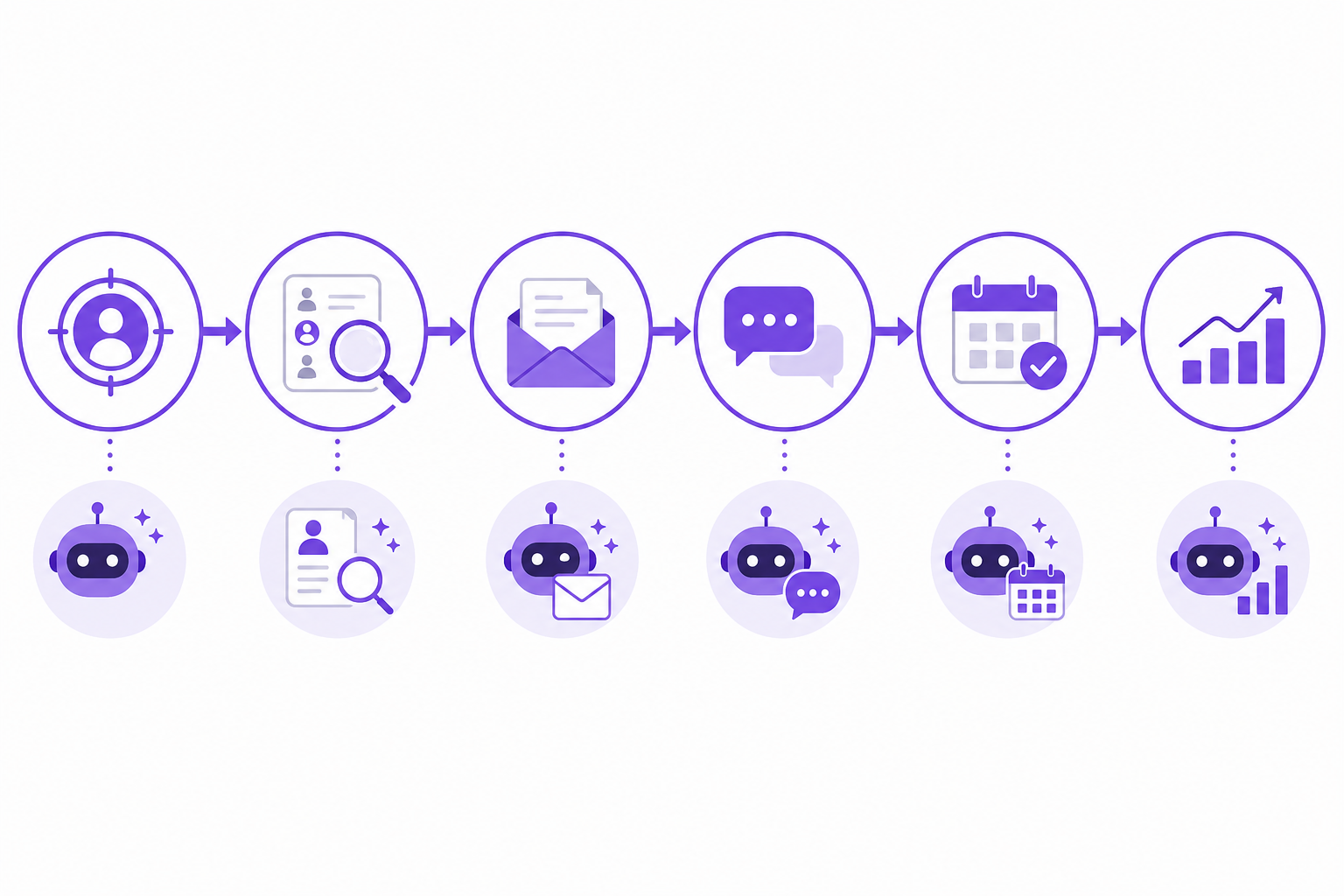
A B2B prospecting workflow is a repeatable sequence of activities that moves target accounts from identification to qualified opportunity. It defines:
- Who to target (ICP criteria)
- How to find them (sourcing channels)
- How to reach them (outreach channels and sequences)
- How to qualify them (discovery and scoring)
- How to hand them off (SDR-to-AE or next stage)
- How to measure success (KPIs and review cadence)
Without workflow discipline, reps improvise daily—producing inconsistent results impossible to scale or improve.
Why Workflow Beats Ad-Hoc Prospecting
Top-performing sales teams share a common trait: they follow systems. Workflow advantages include:
- Predictable pipeline generation week after week
- Faster onboarding—new reps follow documented steps
- Clear accountability with stage-based metrics
- Continuous improvement through A/B testing at each stage
- Better tool ROI—technology supports defined steps, not chaos
- Reduced burnout—structured days beat reactive firefighting
Read autopilot pipeline playbook and building a predictable B2B pipeline.
Stage 1: ICP Alignment and Account Selection
Every prospecting workflow begins with ICP clarity. Before building any list:
- Confirm current ICP document is updated
- Identify Tier 1, Tier 2, and Tier 3 account segments
- Set weekly account targets by tier
- Define disqualification rules reps can apply immediately
Build your ICP with how to build an ideal customer profile and ICP identification guide.
Stage 2: List Building and Account Research
Source accounts from multiple channels for balanced pipeline:
AI-Powered Discovery
Generate ICP-fit account lists in minutes instead of hours. AI platforms filter by industry, size, geography, and technographics. See AI ICP Generator and how SDR teams save time with AI.
LinkedIn and Social Research
Identify accounts showing growth signals, leadership changes, or content engagement relevant to your solution.
Intent Data
Prioritize accounts researching topics aligned with your product category.
Referrals and Warm Introductions
Systematize referral requests from customers, partners, and investors.
Inbound Lead Processing
Route inbound leads through ICP filter before adding to active prospecting queues.
Stage 3: Contact Identification and Verification
For each target account, identify 2–4 contacts across buying roles:
- Primary decision-maker or economic buyer
- Champion or day-to-day evaluator
- Technical or operational influencer
Verify every email and phone number before outreach. Unverified data wastes sequences and damages sender reputation. Follow B2B lead verification and finding decision-makers.
Stage 4: Account and Contact Prioritization
Score accounts and contacts to focus limited time on highest-potential targets:
- A-tier: ICP Tier 1 + buying trigger + verified DM—contact today
- B-tier: ICP fit + verified contact—standard sequence
- C-tier: Partial fit or missing trigger—nurture or monitor
Automate scoring with AI lead qualification. Reps should start each day with a prioritized queue, not a random CRM scroll.
Stage 5: Multi-Channel Outreach Execution
Modern prospecting uses multiple channels in coordinated sequences—not single-channel blasts.
Email Outreach
Primary channel for scale. Personalize first line with company-specific context. Keep initial emails under 120 words. Clear CTA (15-minute call, specific question).
LinkedIn Outreach
Connection requests with personalized notes. Engage with prospect content before pitching. Voice notes and video messages for Tier 1 accounts.
Phone Calls
Highest conversion for qualified accounts. Call after email touch 2–3. Leave concise voicemails referencing prior email.
Video Prospecting
60–90 second personalized videos for strategic accounts. Stand out in crowded inboxes.
Stage 6: Follow-Up Sequences
Most deals require 6–10 touchpoints. A proven 14-day B2B sequence:
- Day 1: Email 1—problem-focused introduction
- Day 2: LinkedIn connection request
- Day 4: Email 2—value insight or case study
- Day 6: Phone call + voicemail
- Day 8: Email 3—different angle or social proof
- Day 10: LinkedIn message or content engagement
- Day 12: Email 4—breakup or direct ask
- Day 14: Final touch—phone or video
Pause sequence on reply. Resume nurture track for non-responders after 30–60 days with new angle.
Stage 7: Response Handling and Qualification
When a prospect responds, switch from prospecting mode to qualification mode:
- Respond within 1 hour during business hours
- Run discovery using BANT, MEDDIC, or your chosen framework
- Document pain, authority, timeline, and next step in CRM
- Book meeting with AE or advance to SQL stage
- Disqualify professionally if not fit
Full qualification process in lead qualification process.
Stage 8: CRM Hygiene and Pipeline Management
Workflow integrity depends on clean CRM data:
- Log every touchpoint (email, call, LinkedIn) against account
- Update lead status at each stage transition
- Record disqualification reasons
- Set follow-up tasks with specific dates
- Review stale opportunities weekly
Friday afternoon CRM hygiene prevents Monday morning chaos.
Daily Prospecting Workflow (SDR Schedule)
A high-output SDR daily structure:
| Time Block | Activity | Duration |
|---|---|---|
| 8:00–8:30 | Review priorities, check replies, plan day | 30 min |
| 8:30–10:30 | Outbound block 1: calls + emails (A-tier accounts) | 2 hours |
| 10:30–11:00 | Respond to replies, book meetings, qualification calls | 30 min |
| 11:00–12:00 | LinkedIn outreach + engagement | 1 hour |
| 1:00–2:30 | Outbound block 2: calls + follow-up emails | 1.5 hours |
| 2:30–3:30 | List building, research, AI prospect generation | 1 hour |
| 3:30–4:00 | CRM updates, log activities, set tomorrow's tasks | 30 min |
Protect outbound blocks from internal meetings. Two focused outbound blocks daily outperform scattered activity.
Weekly Prospecting Workflow
- Monday: Pipeline review, set weekly targets, prioritize A-tier accounts
- Tuesday–Thursday: Execute daily outbound rhythm
- Friday: KPI review, CRM hygiene, list building for next week, team sync
Weekly team reviews cover: meetings booked, reply rates, SQLs created, top-performing messaging, and accounts needing manager support.
Monthly Prospecting Optimization
Monthly workflow review agenda:
- Conversion rates by channel, segment, and sequence step
- ICP tier performance—which segments convert best?
- Messaging A/B test results
- List source quality comparison
- Rep-level performance and coaching needs
- Tool and automation effectiveness
- ICP document updates based on win/loss data
Reallocate effort to highest-converting segments. Kill underperforming sequences. Double down on what works.
Integrating AI Into Your Prospecting Workflow
AI fits specific workflow stages—not as a replacement for the entire process:
- List building: AI discovers ICP-fit accounts at scale
- Research: AI enriches accounts with firmographic and trigger data
- Prioritization: AI scores and ranks daily prospecting queues
- Personalization: AI drafts outreach using company context
- Qualification: AI pre-scores fit before discovery calls
Human reps own conversations, objection handling, and relationship building. See AI workflow for sales teams and AI vs. manual prospecting.
Prospecting Workflow KPIs
- New accounts added to pipeline per week
- Outreach activities per day (calls, emails, LinkedIn)
- Reply rate and positive reply rate
- Meetings booked per week
- SQLs created per month
- Meeting show rate
- SQL-to-opportunity conversion rate
- Pipeline value generated per rep
- Cost per meeting by channel
Track activity and outcome metrics together. High activity with low meetings signals targeting or messaging problems—not effort problems.
Common Prospecting Workflow Mistakes
- No documented workflow—every rep improvises
- Skipping verification before sequences launch
- Single-channel dependence (email-only)
- Stopping follow-up after one or two touches
- No time blocks—outreach squeezed between meetings
- Ignoring CRM updates until end of week
- Not reviewing and optimizing monthly
- Measuring emails sent instead of meetings booked
Avoid these with top B2B lead generation mistakes as a reference checklist.
Frequently Asked Questions
What is the best B2B prospecting workflow in 2026?
The best workflow combines ICP-aligned account selection, verified contact identification, prioritized multi-channel outreach, structured follow-up sequences, discovery-based qualification, CRM hygiene, and weekly KPI reviews—with AI accelerating list building and research stages.
How many touchpoints should a B2B prospecting sequence include?
Most B2B deals require 6–10 touchpoints across email, phone, and LinkedIn over 2–3 weeks. Enterprise deals may need 12+ touches over 4–6 weeks. Always pause on reply and resume nurture for non-responders after 30–60 days.
How should SDRs split time between prospecting activities?
A balanced split: 60% outbound execution (calls, emails, LinkedIn), 20% response handling and qualification, 20% list building and research. Protect two 90-minute outbound blocks daily.
Where does AI fit in a prospecting workflow?
AI accelerates list building, account enrichment, lead scoring, and outreach personalization. Reps focus saved time on calls, discovery, and relationship building—the stages AI cannot replace.
How do you measure prospecting workflow effectiveness?
Track meetings booked, SQLs created, reply rates, and pipeline value generated—not just activity volume. Review weekly for tactical adjustments and monthly for strategic optimization by segment and channel.
Final Thoughts
The best B2B prospecting workflow is not complicated—it is disciplined. Define stages. Block time. Execute sequences. Qualify rigorously. Measure outcomes. Optimize monthly. Teams that follow systems outperform teams that rely on talent alone.
Start with one workflow version. Run it for 30 days. Review results. Refine. The workflow you build and iterate becomes the pipeline engine your company depends on quarter after quarter.
Ready to implement a prospecting workflow that scales? Get started with Adsaga.ai or explore more sales guides on the Adsaga blog.
How Adsaga.ai Powers Your Prospecting Workflow
Adsaga.ai integrates into the highest-leverage stages of B2B prospecting—account discovery, contact identification, and ICP-based prioritization—so your team executes the workflow faster.
With Adsaga.ai, sales teams can:
- Generate ICP-fit account lists in minutes, not days
- Identify verified decision-makers at target companies
- Score and prioritize accounts for daily outreach queues
- Reduce research time by 60% or more per rep
- Improve outreach personalization with enriched company data
- Scale prospecting workflow execution without adding headcount
Implement the workflow in this guide—and use Adsaga.ai to power list building and qualification at every stage. Try Adsaga.ai and build predictable B2B pipeline in 2026.