SDR teams are under pressure to book more meetings with fewer resources. The bottleneck is rarely effort—it is time spent on research, list building, data verification, and manual CRM work instead of conversations that convert. In 2026, the highest-performing SDR teams use AI to reclaim 10–15 hours per week per rep. This guide explains exactly how SDR teams save time with AI—and where to deploy automation without sacrificing outreach quality.
AI does not replace SDRs. It removes the repetitive tasks that prevent SDRs from doing what they were hired for: qualifying prospects, handling objections, and booking meetings with decision-makers.
You will learn which SDR tasks AI handles best, how to redesign daily workflows, what to keep human-led, and how to measure time savings and pipeline impact.
For related context, see AI workflow for sales teams, how AI qualifies B2B leads automatically, and AI vs. manual prospecting.
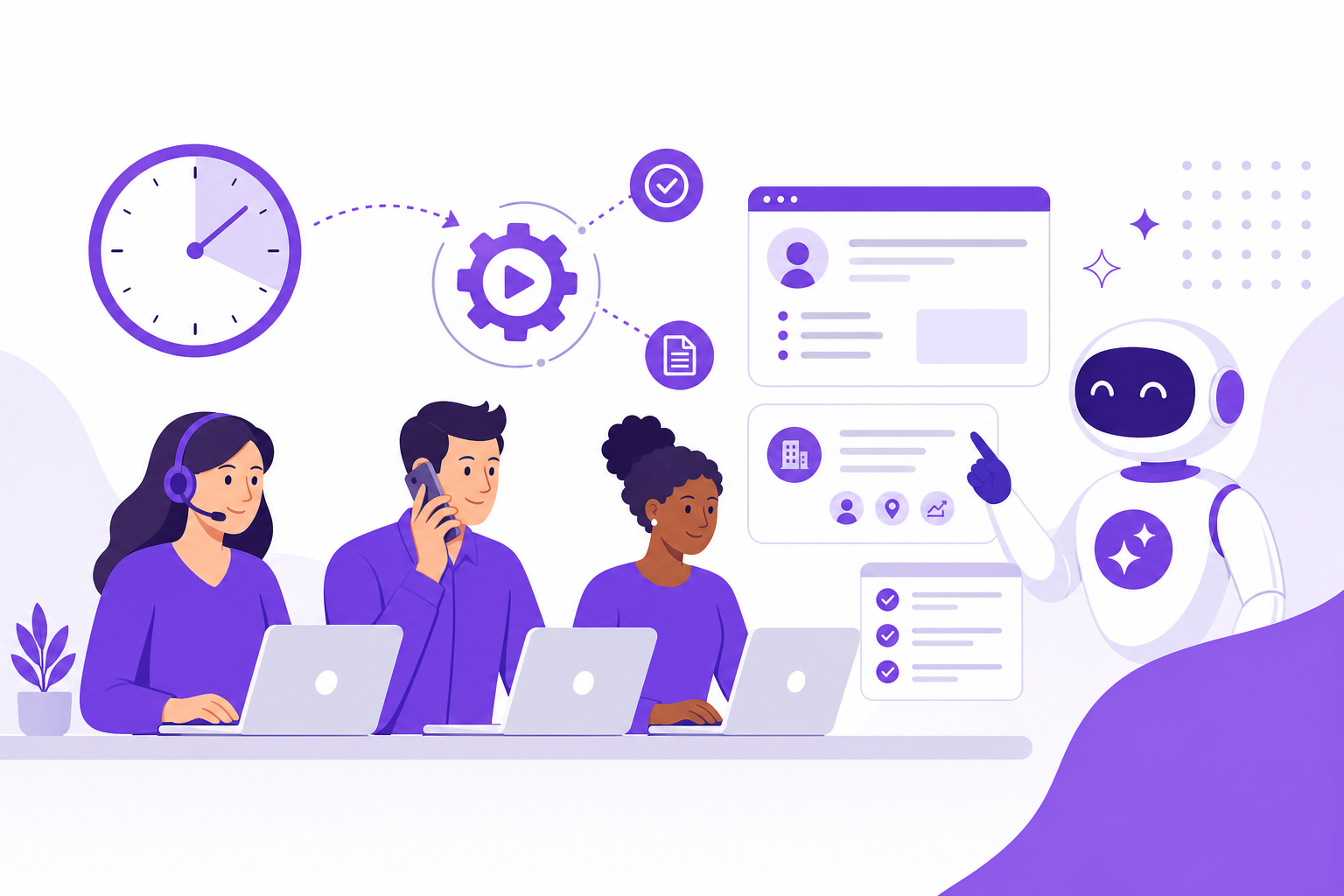
Where SDR Time Actually Goes
Before optimizing with AI, understand the baseline. Studies of SDR activity consistently show:
- 40–60% of time on research and list building
- 20–25% on outreach execution (emails, calls, LinkedIn)
- 10–15% on CRM data entry and admin
- 10–15% on meetings and qualification calls
- 5–10% on internal meetings and training
The irony: SDRs are hired to book meetings, but most of their week is spent preparing to book meetings. AI flips this ratio by automating preparation.
10 Ways SDR Teams Save Time With AI
1. Automated Account Discovery
Instead of manually searching LinkedIn, directories, and databases account by account, AI scans millions of companies and returns lists matching your ICP in minutes. A task that took 4–6 hours manually becomes 15–20 minutes with review.
Connect to ICP building and AI ICP Generator for accurate targeting.
2. Decision-Maker Identification
AI identifies procurement managers, VPs, directors, and other buying roles within target accounts—complete with title, department, and contact paths. Reps stop guessing which contact to pursue.
See how AI finds B2B decision-makers and decision-maker prospecting guide.
3. Contact Verification at Scale
AI verifies email deliverability and employment status before outreach. Reps avoid bounced emails, wasted sequences, and domain reputation damage. Verification that took 2–3 hours per list happens automatically.
Follow B2B lead verification best practices.
4. ICP-Based Lead Scoring
AI scores every account by firmographic fit, intent signals, and engagement—producing a prioritized daily queue. Reps start each morning knowing exactly which accounts to contact first.
Learn how AI qualifies leads and lead qualification process.
5. Account Enrichment and Research Briefs
AI compiles company context—industry, size, recent news, technology stack, hiring patterns—into research briefs reps review in 2 minutes instead of researching for 20 minutes per account.
6. Personalized Outreach Drafting
AI drafts email and LinkedIn message first lines using company-specific context. Reps edit and send instead of writing from scratch. Personalization at scale without sacrificing relevance.
Human review remains essential—AI drafts, reps refine tone and accuracy.
7. Sequence Optimization
AI analyzes which email templates, subject lines, and send times produce highest reply rates for your ICP. Continuous A/B testing without manual spreadsheet tracking.
8. CRM Auto-Logging and Data Hygiene
AI tools sync outreach activity to CRM automatically—logging emails, calls, and LinkedIn touches without manual entry. Clean data without the admin burden.
9. Meeting Scheduling Automation
When prospects reply positively, AI scheduling tools eliminate back-and-forth emails. Reps share a link; meetings book directly on AE calendars.
10. Pipeline Reporting and Coaching Insights
AI dashboards surface rep-level metrics—activities, reply rates, meetings booked, conversion by segment—so managers coach with data instead of gut instinct.
Redesigning the SDR Day With AI
Here is how a 10-hour SDR day shifts when AI handles research and admin:
| Activity | Without AI | With AI |
|---|---|---|
| Research and list building | 3–4 hours | 45–60 minutes (review AI output) |
| Outreach execution | 2 hours | 3.5–4 hours |
| CRM and admin | 1–1.5 hours | 20–30 minutes |
| Qualification calls | 1 hour | 1.5–2 hours |
| Internal meetings | 45 minutes | 45 minutes |
The gain: 2+ additional hours daily on outreach and conversations—the activities that directly produce meetings.
What SDRs Should Keep Human-Led
AI saves time on preparation, not persuasion. Keep these human:
- Discovery calls: Pain exploration, rapport, qualification questions
- Objection handling: Responding to "not interested," "bad timing," "using competitor"
- Tier 1 account strategy: Multi-threaded outreach, executive engagement, custom research
- Outreach tone review: AI drafts need human editing for brand voice and accuracy
- Handoff conversations: SDR-to-AE briefings with context and relationship notes
- Strategic account planning: Which accounts deserve executive involvement
Teams that fully automate outreach without human review see reply rates drop. AI + human judgment is the winning combination.
Implementing AI in Your SDR Workflow: Step by Step
- Audit current time allocation: Track one week of SDR activities to find biggest time sinks
- Define ICP: AI needs clear targeting criteria to produce useful output
- Select AI tools: Prioritize discovery, verification, and scoring over full automation
- Pilot with 2–3 reps: Run parallel workflow for 30 days
- Measure time savings: Compare research hours, meetings booked, and reply rates
- Redesign daily schedule: Reallocate saved time to outbound blocks
- Train the full team: Document workflow, run onboarding sessions
- Review monthly: Optimize AI usage based on performance data
Follow B2B prospecting workflow and sales prospecting guide as structural foundations.
AI Tools SDR Teams Use in 2026
Evaluate tools by the time they save on specific workflow stages:
- Account discovery: AI platforms that find ICP-fit companies globally
- Contact data: Verified email and phone enrichment
- Lead scoring: Automated fit and intent scoring
- Outreach platforms: Multi-channel sequences with AI personalization
- CRM automation: Activity logging and pipeline updates
- Conversation intelligence: Call recording, transcription, coaching insights
Compare options in AI sales prospecting tools compared. Avoid tool sprawl—pick platforms that cover multiple workflow stages.
Measuring AI Impact on SDR Productivity
Track before-and-after metrics during AI rollout:
- Hours spent on research per rep per week
- Accounts added to pipeline per week
- Outreach activities per day (should increase)
- Reply rate and positive reply rate
- Meetings booked per rep per week
- SQLs created per month
- Cost per meeting
- Time from new account to first outreach
Expect measurable improvement within 30–60 days of structured implementation. If meetings booked do not increase despite time savings, the issue is targeting or messaging—not AI adoption.
Common Mistakes When Adopting AI for SDR Teams
- Automating outreach without human review—reply rates suffer
- Skipping ICP definition—AI produces irrelevant lists fast
- Measuring time saved but not meetings booked
- Adding AI tools without redesigning daily workflow
- Expecting AI to replace SDR headcount immediately
- Ignoring data verification—AI output still needs quality checks
- No training—invest in onboarding for AI-assisted workflows
- Tool sprawl—too many disconnected platforms create new admin burden
AI for SDR Teams: ROI Calculation
A practical ROI model for SDR team AI investment:
- Time saved: 10 hours/week × $30/hour loaded cost = $300/rep/week
- Additional meetings: 3–5 more meetings/week × 25% close rate × $ACV
- Reduced data costs: Less spending on unverified purchased lists
- Faster ramp: New SDRs productive in 3 weeks instead of 6
For a 5-person SDR team, 10 hours saved per rep weekly equals 50 hours of reclaimed selling time—equivalent to adding more than one full-time rep without hiring.
Building an AI-First SDR Culture
Technology alone does not change outcomes—culture does. AI-first SDR teams:
- Treat AI as a daily tool, not an occasional experiment
- Share winning prompts, sequences, and workflows across the team
- Review AI output quality in weekly team meetings
- Celebrate meetings booked, not hours researched
- Invest in continuous training as AI capabilities evolve
- Give reps permission to disqualify AI-suggested accounts that do not fit
Leadership must model AI usage and protect outbound time blocks that AI makes possible.
Frequently Asked Questions
How much time can SDR teams save with AI?
SDR teams typically reclaim 10–15 hours per rep per week by automating account discovery, contact verification, lead scoring, research briefs, and CRM logging—redirecting that time to outreach and qualification calls.
Will AI replace SDR jobs?
AI automates research and admin, not persuasion and relationship-building. SDR roles evolve toward higher-value conversations. Teams using AI book more meetings—they do not eliminate SDR positions.
What SDR tasks should not be automated?
Keep discovery calls, objection handling, Tier 1 account strategy, outreach tone review, SDR-to-AE handoffs, and strategic account planning human-led. AI prepares; humans persuade.
How long does it take to see ROI from SDR AI tools?
Most teams see measurable time savings within 2 weeks and pipeline impact (more meetings booked) within 30–60 days of structured implementation with ICP-defined targeting.
What is the best first AI tool for SDR teams?
Start with AI account discovery and ICP-based list building—it addresses the largest time sink (40–60% of SDR week). Add verification and scoring next, then outreach personalization.
Final Thoughts
SDR teams that adopt AI in 2026 do not work less—they work on higher-value activities. Research, verification, and admin shrink. Conversations, qualification, and meeting booking grow. The reps who embrace AI-assisted workflows will outperform those who compete on manual effort alone.
Start with one workflow stage. Measure time saved. Reallocate hours to outreach. Scale what works. The SDR team of 2026 is not bigger—it is faster, smarter, and more focused because AI handles everything that is not a conversation.
Ready to give your SDR team 10+ hours back every week? Get started with Adsaga.ai or explore more sales guides on the Adsaga blog.
How Adsaga.ai Saves SDR Teams Time Every Day
Adsaga.ai is built for SDR teams drowning in manual research. The platform automates the highest-volume time sinks—account discovery, decision-maker identification, and ICP scoring—so reps spend their day booking meetings, not building lists.
With Adsaga.ai, SDR teams can:
- Generate ICP-fit prospect lists in minutes instead of hours
- Identify verified decision-makers at target accounts automatically
- Score and prioritize daily outreach queues by fit and intent
- Reclaim 10–15 hours per rep per week from manual research
- Increase outreach volume without sacrificing personalization
- Book more meetings with the same team size
Give your SDR team the AI advantage described in this guide. Try Adsaga.ai and transform SDR productivity in 2026.