Ten hours per week is the difference between an SDR team that hits quota and one that burns out on research. When AI handles account discovery, contact identification, verification, and scoring, reps reclaim 10 hours weekly—50 hours per month—per person. Across a 5-person team, that is 250 hours monthly redirected from spreadsheets to conversations.
This guide breaks down exactly where those 10 hours come from, how to verify the savings, and how to reinvest reclaimed time into outreach that books meetings.
For related context, see how SDR teams save time with AI, sales team productivity calculator, and why manual prospecting is slow.
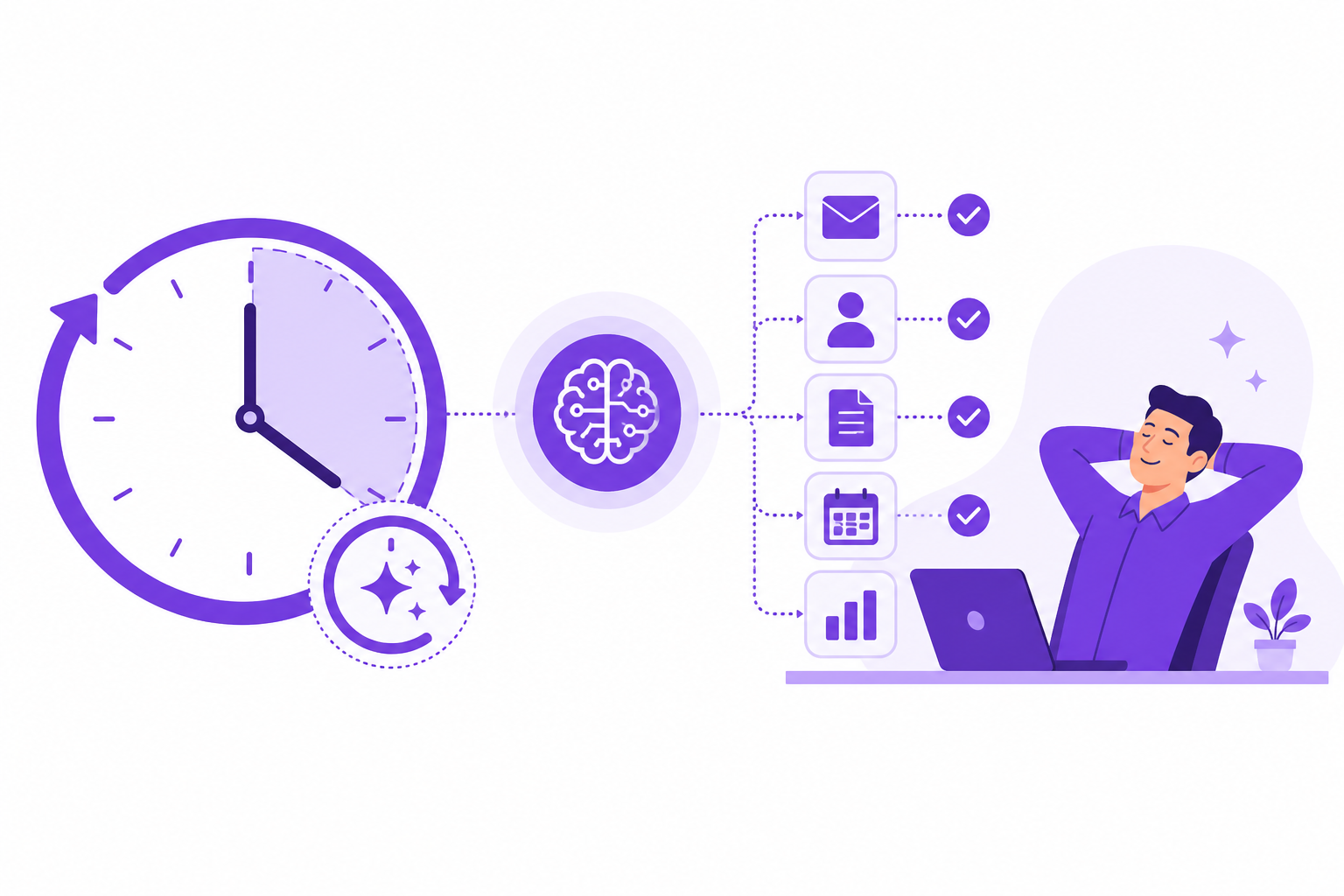
Where 10 Hours Per Week Actually Comes From
| Task | Manual Time | With AI | Hours Saved |
|---|---|---|---|
| Account discovery (50 accounts) | 4–6 hours | 20–30 min | 3.5–5.5 hrs |
| Decision-maker identification | 3–4 hours | Included in workflow | 3–4 hrs |
| Contact verification | 1.5–2 hours | Automated | 1.5–2 hrs |
| ICP scoring and prioritization | 1–2 hours | Automated tiers | 1–2 hrs |
| Account enrichment/research | 2–3 hours | 30 min review | 1.5–2.5 hrs |
| CRM data entry | 1–1.5 hours | 15–20 min | 0.8–1.3 hrs |
| Total weekly savings | 11.8–16.3 hrs |
Conservative estimate: 10 hours saved per rep per week. High-performing implementations save 12–16 hours.
Strategy tip: Reinvest saved hours into outreach, not more meetings
The 10 hours saved only produce ROI when redirected to outreach execution and qualification calls—not absorbed by more internal meetings or admin.
Dollar Value of 10 Hours Weekly
Per SDR (annual):
- 10 hours × 50 weeks = 500 hours reclaimed
- 500 hours × $43.75 loaded rate = $21,875/year
5-person SDR team (annual): $109,375 in reclaimed capacity
Equivalent headcount: 500 hours ÷ 2,000 annual hours = 0.25 FTE per rep — a 5-person team gains 1.25 FTE equivalent without hiring.
What Changes in the SDR Week
| Activity | Before AI (40 hr week) | After AI (40 hr week) |
|---|---|---|
| Research and list building | 16 hours (40%) | 5 hours (12%) |
| Outreach execution | 10 hours (25%) | 18 hours (45%) |
| Qualification calls | 4 hours (10%) | 6 hours (15%) |
| CRM and admin | 6 hours (15%) | 3 hours (8%) |
| Internal meetings | 4 hours (10%) | 4 hours (10%) |
| Training and coaching | 2 hours (5%) | 4 hours (10%) |
Outreach time nearly doubles. That is where meetings come from.
How to Verify Your Team Saves 10 Hours
- Baseline week: Reps log hours by category before AI implementation
- Implement AI workflow: Configure ICP, run first batch, integrate with outreach
- Measure week 4: Reps log hours again using same categories
- Compare: Research hours should drop 10–15 hours; outreach hours should rise 8–12 hours
- Validate outcomes: Meetings booked should increase 30–50% within 60 days
The Adsaga.ai 10-Hour Workflow
Here is how Adsaga.ai specifically reclaims 10 hours:
- Create configuration (
/workflow/config/create) — 30 minutes one-time. Plain-language ICP with industries, locations, designations, company size, and custom instructions. Auto-fill form accelerates setup. - Run workflow (
/workflow/workflows) — 5 minutes per run. Select config and AI model. Status shows Running → Queued → Finished. - Review leads — 45–60 minutes. Filter Tier A and B. Check ICP score, Receptivity score, Total score (0–100). Expand reasons for each lead.
- Export to outreach — 15 minutes. Import qualified tiers to sequencer. Skip Tier C and D.
- Re-run weekly — Same config, fresh batch. No rebuilding from scratch.
Total active time: ~2 hours vs. 12–16 hours manual. Savings: 10–14 hours weekly.
Common Mistakes That Prevent 10-Hour Savings
- Exporting all tiers instead of filtering A/B — wastes outreach time on bad leads
- Re-researching AI output manually — trust the scores, spot-check Tier A only
- Not re-running workflows — rebuilding lists from scratch each week
- Absorbing saved hours into admin — protect outreach time explicitly
- Skipping ICP configuration — broad targeting reduces score accuracy
Frequently Asked Questions
How does AI save sales teams 10 hours weekly?
AI automates account discovery, decision-maker identification, contact verification, ICP scoring, and enrichment—tasks that consume 12–18 hours manually. Reps spend 1–2 hours reviewing AI output instead of building lists from scratch.
Is 10 hours per week realistic?
Yes. Conservative implementations save 8–10 hours. Teams with strong ICP configs and workflow discipline save 12–16 hours. The savings are verifiable through time-tracking before and after implementation.
What should SDRs do with 10 extra hours?
Redirect to outreach execution (emails, calls, LinkedIn) and qualification conversations. Outreach time should increase from 25% to 40–45% of the week. This is where meeting volume gains materialize.
How quickly do teams see the 10-hour savings?
First workflow run saves 8–12 hours immediately. By week 3–4, reps complete review in under 2 hours as they learn the platform. Full 10-hour savings is consistent by month two.
Does AI save AE time too?
Indirectly. Better-qualified SDR handoffs reduce AE time on unqualified discovery calls by 30–50%. AEs receive scored, tiered prospects with context—saving 2–4 hours weekly per AE.
Final Thoughts
Ten hours per week per rep is not a marketing claim—it is arithmetic. Manual prospecting consumes 40% of the SDR week. AI reduces that to 12%. The hours are real. The question is whether your team reinvests them in outreach or lets them disappear into admin.
Configure once. Run weekly. Review tiers. Export qualified leads. Reclaim 10 hours. Book more meetings.