
Your SDRs start Monday with a quota of 50 meaningful conversations. By Wednesday they are still building spreadsheets. Why manual prospecting is slow is not a mystery—fragmented data, repetitive research, inconsistent qualification, and copy-paste CRM work consume 30–40% of every rep's week before a single email sends. This guide diagnoses the bottlenecks and shows what high-performing B2B teams do instead.
Manual prospecting made sense when markets were local and buyer lists were short. In 2026, reps researching across industries, geographies, and databases cannot keep pace without workflow automation. The goal is not to eliminate human judgment—it is to eliminate the grunt work that prevents judgment from being applied.
Continue with: lead qualification process, how to find qualified B2B leads, how to verify B2B leads before outreach, AI workflow for sales teams, and lead research automation.
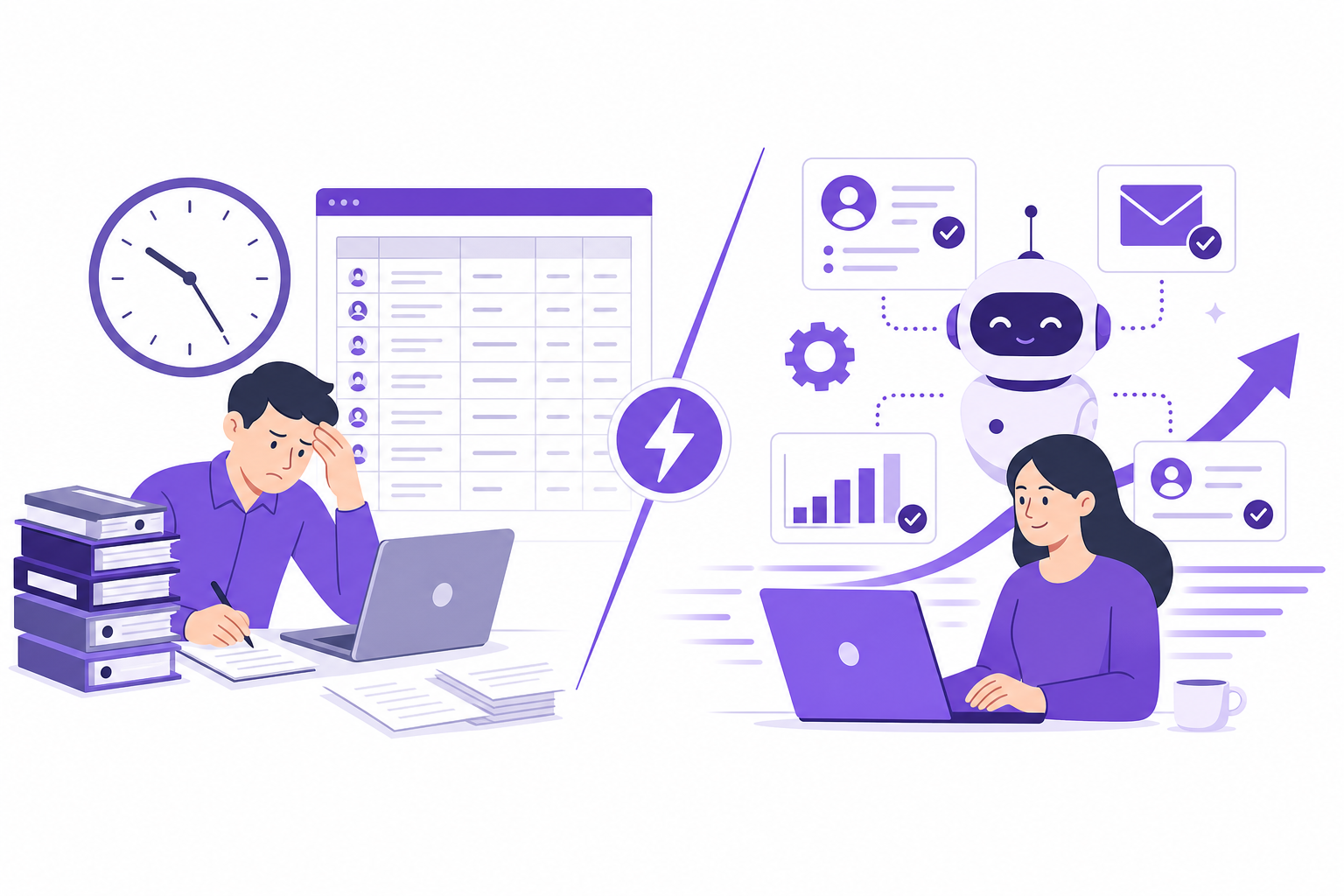
Where Manual Prospecting Time Actually Goes
SDRs rarely admit they are "slow"—they are buried. A typical manual prospecting week breaks down like this:
- Account discovery (25–35%): Searching databases, Google, LinkedIn, and industry directories for ICP-fit companies
- Contact identification (15–20%): Finding the right decision-maker title and contact details
- Verification (10–15%): Checking emails, employment, and company details across sources
- Qualification and scoring (10%): Deciding whether each account deserves outreach
- CRM data entry (10–15%): Copy-pasting fields, fixing formatting, assigning owners
- Actual outreach (20–30%): Emails, calls, LinkedIn—the work that books meetings
When research and admin consume 60–70% of the week, prospecting feels slow because selling is not the primary activity.
Why Manual Prospecting Is Slow: 8 Bottlenecks
1. Data Lives in Too Many Places
Company info on LinkedIn. Revenue on a database. Contacts in a spreadsheet. Verification in another tool. Reps tab-switch through six platforms to build one account record. Context switching alone can cost 20–30% of productive time.
2. No Repeatable Discovery Process
Each rep builds lists differently. One filters by industry; another searches keywords. Inconsistent methods produce inconsistent pipeline—and every new territory or vertical resets the learning curve.
3. Manual ICP Qualification Does Not Scale
Judging whether each company fits ICP requires reading websites, checking employee counts, and cross-referencing criteria. At 50 accounts per day, thorough qualification is physically impossible manually—so reps cut corners.
4. Decision-Maker Hunting on LinkedIn
Scrolling org charts and guessing titles is slow and error-prone. Reps find someone—but not always the person who owns budget for your solution. Wrong contacts mean slow cycles even when outreach starts.
5. Verification Is Tedious and Skipped
Email verification tools exist, but manual workflows often skip them under time pressure. Skipping verification creates bounce cleanup later—more slow work disguised as outreach.
6. Spreadsheet List Management
Lists live in Excel or Google Sheets outside CRM. Duplicates accumulate. Ownership gets unclear. Merging spreadsheet data into CRM weekly is a manual reconciliation project—not selling.
7. New Rep Ramp Takes Months
Manual prospecting knowledge is tribal. New SDRs spend 4–8 weeks learning where to look, how to qualify, and which sources to trust. Until ramp completes, every rep is slow by design.
8. Scaling to New Segments Multiplies Effort
Entering a new industry or geography resets research from zero. Manual prospecting scales linearly with headcount—hire more reps, spend more hours, get more lists. There is no leverage.
The Business Cost of Slow Prospecting
| Impact | Consequence |
|---|---|
| Fewer conversations | Reps book 30–50% fewer meetings than time reallocation would allow |
| Delayed territory penetration | New markets take quarters instead of weeks to activate |
| Higher cost per meeting | Loaded rep cost spread across fewer qualified opportunities |
| Inconsistent pipeline | Some reps thrive; others drown in research variance |
| Missed timing windows | Triggers pass before accounts enter sequences |
Slow prospecting is not an individual performance issue when the entire team shares the same manual workflow. The system is the bottleneck.
What to Do Instead: Faster Prospecting Without Sacrificing Quality
Solution 1: Document and Standardize Your Prospecting Workflow
Write the seven steps from ICP to CRM export. Every rep follows the same path. Standardization removes reinvention and makes automation possible. Start from how to find qualified B2B leads.
Solution 2: Automate Company Discovery First
AI discovery tools find ICP-fit companies in minutes—not hours. This is the highest-leverage automation because account discovery consumes the largest time block. See lead research automation.
Solution 3: Automate Decision-Maker Identification
Configure role targets—VP Operations, Procurement Director, CEO—and let workflow tools map contacts by title and seniority. Reps review instead of hunt.
Solution 4: Build Verification Into the Workflow
Verification should be a system step, not a rep decision. No contact exports to CRM or sequencer without passing deliverability and employment checks. Read how to verify B2B leads before outreach.
Solution 5: Score and Tier Before Outreach
Automated ICP scoring sorts A/B/C accounts overnight. Reps start each morning with a prioritized queue—not a blank search bar. Apply lead qualification process thresholds to tier definitions.
Solution 6: Integrate CRM Export
Eliminate spreadsheet middlemen. Qualified, verified, scored leads should flow directly into CRM with standard fields and ownership. One click replaces 20 minutes of copy-paste.
Solution 7: Protect Outreach Time Blocks
Schedule 9–11 AM and 2–4 PM as sacred outreach windows. Research and list building happen before 9 AM or via automation—not during prime calling hours.
Solution 8: Adopt an AI-First Prospecting Stack
Replace five manual tools with one workflow platform that covers discovery, enrichment, scoring, and export. Fewer tools means less tab switching. See AI workflow for sales teams.
Manual vs. Automated Prospecting: Time Comparison
| Task | Manual Time | Automated Time |
|---|---|---|
| Build 100-account ICP list | 6–10 hours | 15–30 minutes |
| Find decision-makers at 50 accounts | 3–5 hours | 10–20 minutes |
| Verify 100 contacts | 2–3 hours | 15–30 minutes |
| Score and tier accounts | 2–4 hours | Automatic |
| CRM data entry | 1–2 hours | 5–10 minutes (export) |
Teams typically reclaim 10–15 hours per rep per week—equivalent to adding a full day of selling to every week.
30-Day Transition Plan: Manual to Workflow Prospecting
- Week 1: Document current workflow and time audit per rep
- Week 2: Define ICP config and tier thresholds; pilot AI discovery on one segment
- Week 3: Add verification and CRM export; compare list quality to manual baseline
- Week 4: Roll out to full team; reallocate saved hours to outreach blocks; measure meetings booked
Expect measurable time savings within two weeks and meeting volume lift within 30–60 days if targeting and messaging are sound.
Frequently Asked Questions
Why is manual B2B prospecting so slow?
Manual prospecting requires reps to search multiple data sources, identify decision-makers individually, verify contacts by hand, qualify against ICP criteria, and enter data into CRM—consuming 60–70% of the week before outreach begins.
How many hours do SDRs spend on manual research?
SDRs typically spend 15–20 hours per week on manual account discovery, contact identification, verification, and CRM admin. That is 35–45% of a standard 40-hour week diverted from conversations and meetings.
Does automating prospecting reduce lead quality?
Not when automation includes ICP scoring and verification. Quality drops when teams automate outreach without automating qualification. Discovery and scoring automation typically improve consistency versus manual corner-cutting under time pressure.
What should sales teams automate first?
Automate company discovery and decision-maker identification first—they consume the most time. Add verification and scoring next, then CRM export. Keep messaging, calls, and discovery conversations human-led.
Can small teams benefit from prospecting automation?
Yes. Small teams gain the most per rep because there is no spare capacity to waste on manual research. One SDR reclaiming 12 hours weekly sees immediate meeting volume impact without additional headcount.
Final Thoughts
Manual prospecting is slow because the workflow was designed for a smaller, simpler market. Tab-switching, spreadsheet management, and repetitive qualification cannot keep pace with modern B2B expectations.
Speed comes from systems—not speed-reading LinkedIn. Automate discovery, verification, and scoring. Protect outreach blocks. Measure meetings booked, not hours researched. The fastest prospecting teams in 2026 do less manual work and more selling.
Ready to replace slow manual prospecting? Get started with Adsaga.ai or explore more sales guides on the Adsaga blog.
How Adsaga.ai Replaces Slow Manual Prospecting
Adsaga.ai compresses the slowest prospecting steps—discovery, decision-maker mapping, and ICP scoring—into a workflow that runs in minutes instead of days.
Adsaga.ai workflow at a glance
Create Config (define your business and ICP) → Run Workflow (AI discovers companies and decision-makers) → View Tiered Leads with ICP fit and receptivity scores → export to CRM
Step 1: Create Config
Describe your product, ICP, geography, and buyer roles once. Adsaga.ai structures discovery criteria—eliminating the manual filter-building and keyword searching that eats hours every week.
Step 2: Run Workflow
AI discovers ICP-matched companies, identifies decision-makers, and enriches firmographic data automatically. What took a rep a full day happens while your team focuses on outreach.
Step 3: View Tiered Leads with ICP and Receptivity Scores
Review scored A/B/C tier lists and export to CRM in one step. No spreadsheets. No copy-paste. Reps start Monday with a qualified queue—not an empty search bar.
Stop losing days to manual research. Try Adsaga.ai and prospect at workflow speed in 2026.