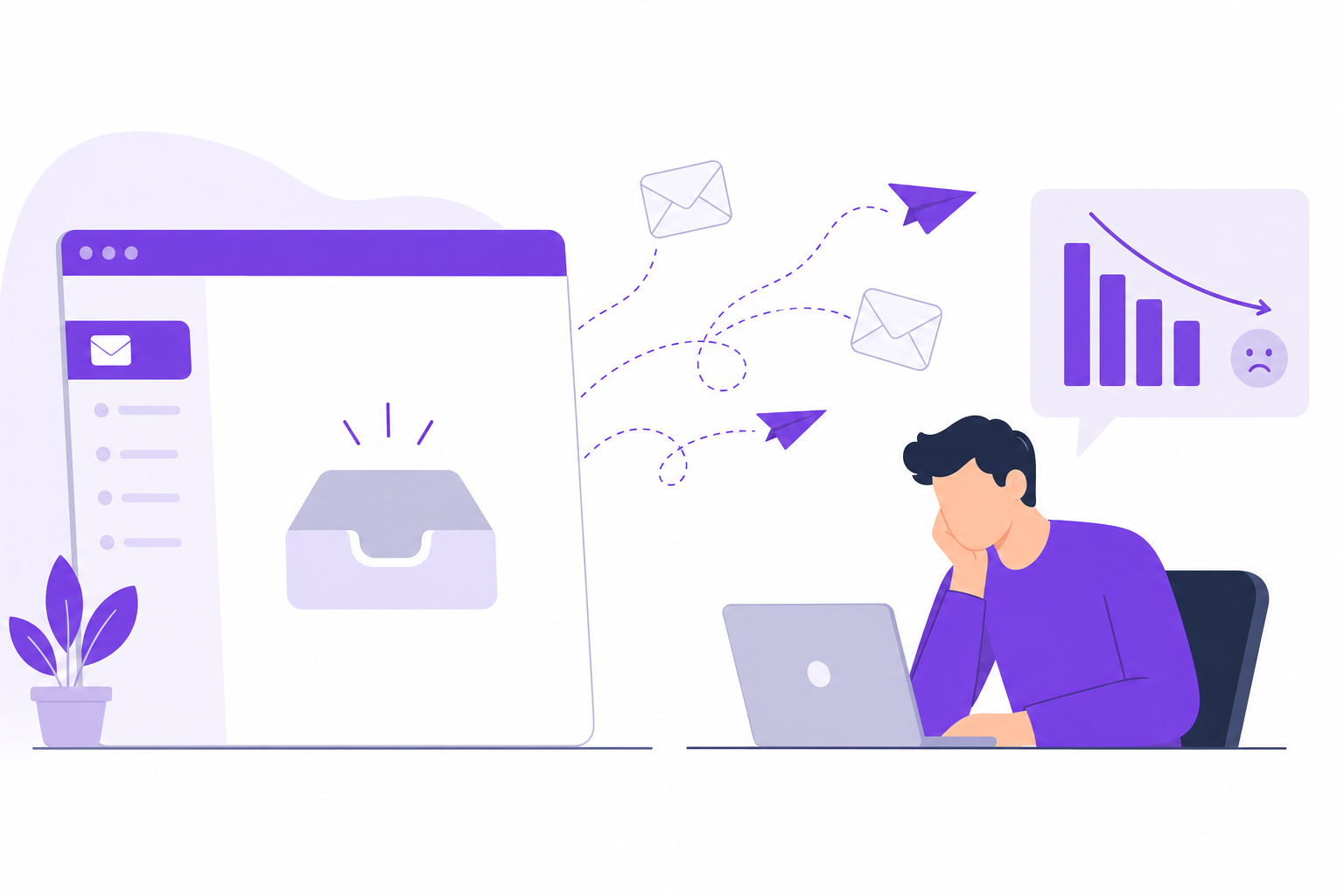
You send hundreds of cold emails every week. Reply rates sit below 2%. Meetings are scarce. Your domain reputation is slipping. If cold email isn't working for your B2B sales team in 2026, the problem is rarely the channel itself—it is almost always targeting, timing, data quality, or message-market fit. This guide diagnoses why outbound email fails, what it costs your pipeline, and the specific fixes that restore reply rates and booked meetings.
Sales leaders often blame copywriters or SDR effort when cold email underperforms. In reality, the root cause is upstream: wrong accounts, wrong contacts, generic lists, and no qualification before send. Fixing cold email starts with fixing who enters your outreach queue.
You will learn the most common failure patterns, a diagnostic framework to audit your outbound program, practical fixes for each root cause, and how modern AI workflows change the economics of cold email in 2026.
For related context, see how sales teams find qualified leads, lead qualification process, and AI prospecting vs manual prospecting.
The Cold Email Crisis: Symptoms Your Team Will Recognize
When cold email stops working, the symptoms appear across your entire outbound motion—not just in one metric. Common warning signs include:
- Reply rates below 3% on personalized sequences (industry benchmark for well-targeted B2B outbound is 5–15%)
- High bounce rates (above 3%) damaging sender reputation
- Meetings booked per 1,000 emails trending down quarter over quarter
- SDRs reporting burnout from high activity with low results
- Spam complaints or emails landing in promotions tabs
- Positive replies from wrong-fit companies that never convert to pipeline
- AE complaints that SDR meetings are low quality
If three or more of these apply, your problem is systemic—not a copywriting tweak away from a fix.
Root Cause 1: You Are Emailing the Wrong Companies
The single biggest reason cold email fails is ICP misalignment. Reps pull lists from databases using broad filters—"companies with 50–500 employees in SaaS"—and blast everyone who matches. Most of those companies will never buy.
Wrong-company outreach produces:
- Ignored emails (prospect has no relevant pain)
- Angry replies ("we're not your customer")
- Wasted SDR hours on accounts outside your win zone
- Inflated activity metrics that mask pipeline weakness
Before rewriting subject lines, audit your last 500 sent emails. How many went to companies that match your documented Ideal Customer Profile? If you do not have a documented ICP, that is your first fix. Build one with how to identify your ideal customer profile and AI ICP Generator explained.
Strategy tip: Qualify before you send
Every email to a non-ICP account is a negative signal—to your domain reputation and your SDR morale. Reduce send volume by 40% and restrict outreach to ICP-fit accounts only. Reply rates typically double when targeting tightens.
Root Cause 2: You Are Reaching the Wrong People
Even ICP-fit companies fail when you email the wrong role. Sending to a marketing coordinator when you need a VP of Operations wastes a touch and sometimes burns the account—especially in smaller companies where one bad email closes the door.
Common contact-targeting mistakes:
- Defaulting to CEO at companies above 100 employees (they delegate)
- Targeting titles that sound right but lack budget authority
- Ignoring the buying committee on larger deals
- Using stale data—contacts who changed roles 6 months ago
Map decision-maker roles for your deal size before building lists. For each ICP segment, document the primary economic buyer, champion, and influencer titles.
Root Cause 3: Your Data Is Stale, Incomplete, or Wrong
Cold email dies in the inbox when data is bad. Bounced emails hurt deliverability for your entire domain. Wrong names destroy credibility in the first line. Outdated titles signal you did not do basic research.
Data quality checklist before any campaign:
- Verify email deliverability (target bounce rate under 2%)
- Confirm contact still works at the company (LinkedIn cross-check)
- Validate company firmographics match ICP (size, industry, geography)
- Remove role-based emails (info@, sales@) from outbound sequences
- Deduplicate against CRM—never email existing customers or active opportunities
Database exports without verification are a deliverability time bomb. See how AI qualifies B2B leads automatically for pre-send scoring approaches.
Root Cause 4: Personalization Is Shallow or Fake
Prospects in 2026 recognize template personalization instantly. "I noticed you work at [Company]" and "Congrats on your recent funding" (from a scraped press release) no longer differentiate you—they signal mass blast.
Personalization that actually works connects your offer to a specific, verifiable business context:
- A operational challenge typical for their industry and size
- A recent company event that creates buying urgency (expansion, compliance deadline, leadership change)
- A relevant customer outcome in a similar company
- A specific workflow pain your product addresses
Depth beats breadth. Ten emails with genuine context outperform 200 with mail-merge fields. The research bottleneck is why teams adopt AI prospecting—see AI prospecting vs manual prospecting.
Root Cause 5: Deliverability and Sending Infrastructure
Technical failures silently kill cold email programs. If your emails never reach the primary inbox, nothing else matters.
Deliverability audit checklist:
- SPF, DKIM, DMARC configured correctly on sending domain
- Domain warm-up completed before high-volume sends
- Separate domains for outbound vs. transactional email
- Send volume limits per mailbox (typically 30–50 new contacts/day for cold outreach)
- Low spam complaint rate (under 0.1%)
- Clean list hygiene—remove hard bounces immediately
One week of sending to unverified lists can take months to recover from. Pause campaigns and fix infrastructure before scaling again.
Root Cause 6: Volume Over Quality Culture
Sales leaders who measure SDR success by emails sent incentivize the exact behavior that kills cold email. High-volume, low-fit outreach trains prospects to ignore you and trains reps to prioritize activity over outcomes.
Shift metrics from activity to outcomes:
| Stop measuring | Start measuring |
|---|---|
| Emails sent per day | Reply rate on ICP-fit accounts |
| Total contacts added to sequences | Meetings booked per 100 ICP-fit contacts |
| Calls + emails activity score | SQL conversion rate from outbound |
| List size | Pipeline created per SDR per month |
When compensation and dashboards align with quality, cold email performance improves without sending more messages.
The Consequences of Broken Cold Email
Ignoring cold email failure has compounding costs beyond low reply rates:
- Domain reputation damage affects marketing email, transactional email, and future outbound
- SDR turnover rises when reps feel activity metrics are hollow
- Pipeline gaps when outbound was supposed to be a predictable channel
- Brand perception suffers when prospects associate you with spam
- Tool spend waste on sequencers, databases, and enrichment with poor ROI
- Missed quota when leadership expected outbound to carry pipeline weight
Cold email is repairable—but only if you address root causes, not symptoms.
The Cold Email Recovery Framework: 7 Steps
Use this sequence to rebuild outbound from the ground up:
- Document your ICP with firmographics, disqualifiers, and buyer roles
- Audit your last 30 days of sends—calculate ICP-fit percentage
- Pause or reduce volume until data verification is in place
- Rebuild lists from ICP-qualified accounts with verified decision-makers
- Rewrite sequences around specific pain points, not product features
- Test on a small batch (50–100 ICP-fit contacts) before scaling
- Measure reply and meeting rates on ICP-fit cohort only—then scale what works
Strategy tip: A/B test targeting before copy
Most teams A/B test subject lines while sending to the same bad list. Instead, send the same message to two ICP segments (e.g., 100–250 employees vs. 250–500) and compare reply rates. Targeting tests reveal more than copy tests.
What Good Cold Email Looks Like in 2026
High-performing B2B outbound programs share common traits:
- ICP-fit accounts only—every contact pre-qualified before send
- Verified decision-maker contacts with role relevance confirmed
- 3–5 email sequences with genuine context, not feature dumps
- Reply rates of 5–15% on Tier A accounts
- Meeting show rates above 70% because prospects self-selected through fit
- SDR-to-AE handoffs with documented qualification context
- Continuous list refresh—not recycling the same database export quarterly
The difference is not talent. It is system. Teams with tight targeting and verified data outperform teams with better copywriters and worse lists.
How AI Fixes the Upstream Cold Email Problem
AI does not write better subject lines—it solves the research and qualification bottleneck that makes cold email fail. In 2026, AI-powered prospecting helps teams:
- Discover ICP-fit companies that do not appear in standard database filters
- Identify decision-makers with role and authority relevance
- Score accounts by fit and receptivity before any email is drafted
- Reduce manual research from hours to minutes per account
- Produce tiered lead lists so SDRs start with highest-probability contacts
When upstream qualification improves, cold email copy matters less because you are reaching the right person about a relevant problem. Read how sales teams find qualified leads and lead qualification process for the full workflow.
How Adsaga.ai Fixes Cold Email at the Source
Adsaga.ai addresses the root cause of cold email failure—poor targeting and unqualified lists—before your SDRs write a single subject line. Instead of exporting thousands of contacts from a database and hoping some fit, you define your ICP in plain language and run an AI workflow that returns tiered, scored leads ready for outreach.
Adsaga.ai workflow at a glance
Create Config (describe your business and ICP in plain language—Auto-fill helps structure criteria) → Run Workflow (AI discovers ICP-fit companies and decision-makers) → View Tiered Leads with ICP fit and receptivity scores → export Tier A/B contacts to your sequencer
Step 1: Create Config
Describe your product, target industries, company size, geography, and buyer roles in plain language. Adsaga.ai structures this into ICP criteria—no complex filter building. Use ICP identification guide and AI ICP Generator to sharpen your inputs.
Step 2: Run Workflow
The AI engine discovers companies matching your ICP, identifies relevant decision-makers, and enriches each account with firmographic context. This replaces hours of manual database searching and spreadsheet qualification.
Step 3: View Tiered Leads
Results arrive as Tier A, B, and C lists scored on ICP fit and receptivity. SDRs load Tier A contacts into cold email sequences first—smaller lists, higher reply rates, better domain reputation. Export directly to your CRM or outreach tool.
Cold Email Fix Priority Matrix
| Problem | Impact | Fix priority | Time to fix |
|---|---|---|---|
| No documented ICP | Critical | Immediate | 1–2 weeks |
| Bounce rate above 3% | Critical | Immediate | 1–3 days |
| Wrong contact roles | High | Week 1 | 3–5 days |
| Generic personalization | Medium | Week 2 | 1 week |
| Activity-based metrics | High | Week 1 | 2–4 weeks |
| Stale list recycling | Medium | Week 2 | Ongoing |
Frequently Asked Questions
Why is my cold email reply rate so low?
Low reply rates usually indicate poor targeting—not weak copy. The most common causes are emailing companies outside your ICP, reaching wrong contact roles, using unverified data with bounces, and sending high volume without pre-qualification. Fix targeting and data quality before rewriting sequences.
What is a good B2B cold email reply rate in 2026?
For well-targeted B2B outbound to ICP-fit decision-makers, expect 5–15% reply rates (including positive and negative replies). Positive reply rates of 2–5% are healthy. Below 2% total replies signals a targeting or deliverability problem, not a copy problem.
Should I send fewer cold emails to get better results?
Yes—counterintuitively, reducing send volume while tightening ICP targeting typically improves reply rates, meeting bookings, and domain reputation. Quality-targeted outbound outperforms high-volume spray-and-pray consistently in 2026.
How does AI help fix cold email performance?
AI solves the upstream research and qualification bottleneck. It discovers ICP-fit companies, identifies decision-makers, and scores leads by fit and receptivity before outreach—so SDRs email fewer contacts with higher conversion probability.
Is cold email still effective for B2B sales in 2026?
Cold email remains effective when targeting is precise, data is verified, and messages address relevant pain. It fails when teams treat it as a volume channel. ICP-first outbound with AI-assisted qualification delivers strong ROI for B2B sales teams.
Final Thoughts
Cold email is not dead—it is misused. Teams that blast unqualified lists will keep seeing 1% reply rates and blame the channel. Teams that qualify accounts before sending, verify contacts, and reach decision-makers about real problems will keep booking meetings.
Stop optimizing subject lines on bad lists. Document your ICP. Verify your data. Score accounts before send. Let SDRs focus on Tier A prospects who actually might buy. That is how cold email works in 2026.
Ready to fix cold email at the source? Get started with Adsaga.ai and build ICP-qualified lead lists before your next outbound campaign.