Cost per lead is one of the most misunderstood metrics in B2B sales. Teams celebrate a $15 cost per lead from a database export while ignoring that 90% of those leads never convert—and the real cost per qualified opportunity is $300 or more. If you need to reduce cost per lead in B2B sales, the answer is not cheaper data or more SDR hours. It is better targeting, automated qualification, and eliminating waste upstream before money is spent on outreach.
Sales and marketing leaders under pressure to improve unit economics often cut tool budgets or reduce headcount. Both approaches shrink capacity without fixing efficiency. The sustainable path to lower cost per lead runs through lead quality, process automation, and ICP discipline—not through doing more with less.
This guide breaks down the true components of B2B cost per lead, diagnoses where waste hides in your funnel, and provides a practical framework to reduce cost per qualified lead by 40–60% within one quarter.
For related context, see how sales teams find qualified leads, lead qualification process, and how AI qualifies B2B leads automatically.
The Cost Per Lead Problem: You're Measuring the Wrong Number
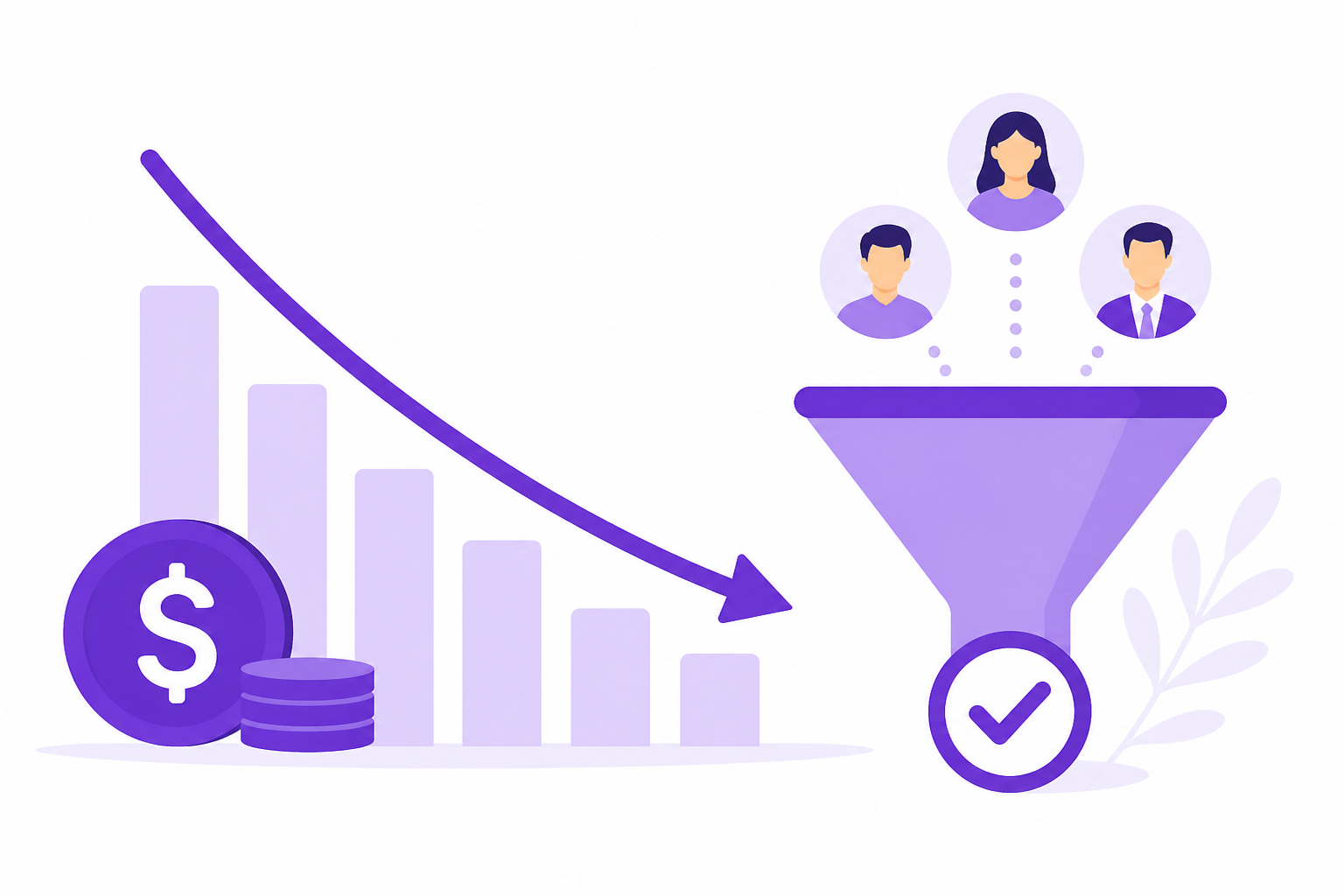
Most B2B teams calculate cost per lead as total sales and marketing spend divided by total contacts acquired. This formula is dangerously misleading because it treats all leads as equal—which they are not.
Consider a team spending $20,000 monthly on tools and SDR salaries that adds 2,000 contacts:
- Reported cost per lead: $10
- Leads that are ICP-fit: 200 (10%)
- True cost per ICP-fit lead: $100
- Leads that become opportunities: 40 (2%)
- True cost per opportunity: $500
The $10 number feels efficient. The $500 number reveals the real problem. Reducing cost per lead starts with measuring cost per qualified lead and cost per opportunity—not cost per contact.
Components of True B2B Cost Per Lead
Build an honest cost model that includes every input:
Direct Costs
- SDR and BDR salaries and commissions
- Sales tool subscriptions (databases, enrichment, sequencer, verifier)
- Marketing spend attributed to lead generation
- Agency or contractor fees for list building
- Data purchase and credit costs
Hidden Costs
- AE time on unqualified meetings: 30–60 min per bad meeting × AE hourly cost
- SDR research time on bad accounts: 15–30 min per unqualified lead
- CRM and ops overhead: Data cleanup, duplicate management, reporting
- Domain reputation recovery: After high-bounce campaigns
- Churn cost: Bad-fit customers acquired through low-quality leads
- Opportunity cost: Revenue from deals not pursued because time went to bad leads
Strategy tip: Calculate cost per opportunity, not cost per contact
True CPL = (Total SDR + AE + tool costs) ÷ Opportunities created. Track this monthly. When you optimize for cost per opportunity instead of cost per contact, the right levers become obvious: better targeting, not cheaper data.
Where Lead Generation Waste Hides
Before cutting costs, identify where money leaks. The five largest waste categories in B2B lead generation:
1. Unqualified List Building (30–50% of waste)
Exporting large contact lists without ICP qualification. Paying for contacts that will never convert. Every dollar spent on unqualified data is wasted at the source.
2. Manual Research Bottleneck (20–30% of waste)
SDRs spending 60–70% of time researching instead of selling. At $30/hour loaded SDR cost, 20 hours of weekly research = $2,400/month per rep on non-selling activity.
3. Bad Meeting Handoffs (15–20% of waste)
AEs attending discovery calls with prospects who were never qualified. Senior sales time is your most expensive resource—wasting it on bad meetings is the highest-cost leak.
4. Tool Overlap and Fragmentation (10–15% of waste)
Multiple tools doing similar jobs—two databases, three enrichment providers, overlapping verification. Consolidation often cuts tool spend 30–40% without losing capability.
5. Low Conversion Follow-Through (10–15% of waste)
Leads that are decent fit but poorly nurtured because SDR bandwidth is consumed by unqualified outreach. Good leads go cold while reps chase bad ones.
Root Cause: No ICP Discipline
Every waste category traces back to the same root cause: prospecting without ICP discipline. When teams do not define, document, and enforce ideal customer criteria, every downstream process becomes inefficient.
ICP discipline directly reduces cost per lead by:
- Eliminating spend on contacts outside your win zone
- Reducing SDR research time (AI handles ICP matching)
- Improving reply rates (relevant outreach to relevant accounts)
- Increasing AE acceptance rates (qualified handoffs)
- Shortening sales cycles (fit drives urgency)
- Reducing churn (customers match the product)
Build ICP discipline with ICP identification guide and AI ICP Generator explained.
The Cost Reduction Framework: 8 Levers
Apply these levers in priority order for maximum impact:
Lever 1: Qualify Before You Pay
Stop paying for contacts before confirming ICP fit. Score accounts before purchasing data or investing SDR time. Pre-qualification eliminates the largest waste category.
Lever 2: Automate Research and Discovery
Replace manual account-by-account research with AI workflows that discover and qualify ICP-fit companies automatically. Reclaim 10–15 SDR hours per week per rep. See AI prospecting vs manual prospecting.
Lever 3: Tier and Prioritize Leads
Not all ICP-fit leads deserve equal investment. Tier A leads get immediate, personalized outreach. Tier B enters standard sequences. Tier C is excluded or nurtured passively. Concentrate spend on highest-probability accounts.
Lever 4: Tighten SDR-to-AE Handoff Criteria
Every unqualified meeting costs $150–$300 in AE time. Define SQL criteria strictly and enforce them. Higher rejection rates at handoff mean lower cost per opportunity downstream.
Lever 5: Consolidate Your Tool Stack
Audit tools for overlap. If your workflow tool handles discovery, enrichment, and scoring, you may not need separate database and enrichment subscriptions. Fewer tools, less tab-hopping, lower total cost.
Lever 6: Measure Cost Per Opportunity by Source
Track which lead sources produce opportunities at the lowest cost. Double down on efficient sources. Cut or restructure expensive, low-converting channels.
Lever 7: Reduce List Size, Increase List Quality
Counterintuitive but proven: smaller, higher-quality lists produce lower cost per opportunity than large, unqualified exports. Fewer contacts × higher conversion = lower unit cost.
Lever 8: Close the Win/Loss Feedback Loop
Feed closed-won and closed-lost data back into ICP criteria quarterly. Targeting precision improves over time, continuously reducing waste.
Cost Per Lead Reduction: Before and After
| Metric | Before (volume model) | After (quality model) |
|---|---|---|
| Monthly contacts added | 2,000 | 400 |
| ICP-fit rate | 10% | 85% |
| ICP-fit leads | 200 | 340 |
| Opportunities created | 40 | 68 |
| Monthly sales cost | $20,000 | $16,000 |
| Cost per contact | $10 | $40 |
| Cost per ICP-fit lead | $100 | $47 |
| Cost per opportunity | $500 | $235 |
Cost per contact rises because you stop counting junk. Cost per opportunity falls because conversion improves at every stage.
Strategy tip: 90-day cost reduction plan
Month 1: Document ICP, audit last 500 leads, calculate true cost per opportunity. Month 2: Implement lead scoring, reduce list size 50%, automate discovery. Month 3: Measure conversion by tier, cut lowest-performing sources, refine ICP. Target: 40% reduction in cost per opportunity.
How AI Reduces Cost Per Lead
AI attacks the two largest cost drivers: unqualified list building and manual research. In 2026, AI-powered prospecting reduces cost per lead by:
- Pre-qualifying accounts before any SDR time or data spend
- Automating discovery that previously required 15–30 min per account
- Scoring and tiering leads so spend concentrates on highest-probability contacts
- Identifying decision-makers without manual LinkedIn research
- Reducing tool fragmentation by combining discovery, enrichment, and scoring in one workflow
Teams using AI workflows report 40–60% reduction in cost per qualified opportunity within 90 days—not from cutting budgets, but from eliminating waste. Learn more in how AI qualifies B2B leads automatically.
Cost Metrics Dashboard: Track Weekly
- Cost per contact added (trending indicator, not primary KPI)
- Cost per ICP-fit lead (primary efficiency metric)
- Cost per SQL (SDR output quality)
- Cost per opportunity (ultimate unit economics)
- Cost per opportunity by source (channel efficiency)
- SDR research hours per qualified lead (process efficiency)
- AE hours on unqualified meetings (handoff quality)
- Tool cost per opportunity (stack efficiency)
How Adsaga.ai Reduces Cost Per Lead
Adsaga.ai lowers cost per lead by eliminating waste at the source—before SDR time, data credits, or AE hours are spent on unqualified accounts.
Adsaga.ai workflow at a glance
Create Config (plain language ICP with Auto-fill) → Run Workflow (AI discovers and qualifies accounts) → View Tiered Leads (Tier A/B with ICP fit + receptivity scores) → invest outreach budget only on highest-probability leads
Step 1: Create Config
Define your ideal customer once in plain language. Auto-fill structures your ICP criteria. No repeated filter building across tools—one config drives every workflow run.
Step 2: Run Workflow
AI discovers ICP-fit companies, identifies decision-makers, and scores accounts—replacing hours of manual research per rep. Predictable workflow pricing replaces per-contact credit anxiety.
Step 3: View Tiered Leads
Tier A and B leads arrive pre-scored. SDRs and AEs invest time only on accounts with demonstrated fit and receptivity. Cost per opportunity drops because conversion rates rise and waste disappears.
Common Cost-Cutting Mistakes to Avoid
- Buying cheaper data: Low-cost, unverified lists increase bounce rates and waste more than they save
- Cutting SDR headcount without fixing process: Fewer reps with the same broken workflow just means less total pipeline
- Reducing outreach volume without improving targeting: Fewer emails to the same bad list does not help
- Optimizing cost per contact instead of cost per opportunity: The wrong metric drives the wrong behavior
- Skipping qualification to hit activity targets: Short-term activity gains create long-term cost increases
Industry Benchmarks: Cost Per Lead in B2B
| Lead type | Typical cost range | Notes |
|---|---|---|
| Raw database contact | $1–$5 | Low cost, 5–15% ICP-fit rate |
| ICP-fit contact (manual research) | $50–$150 | High SDR time investment |
| ICP-fit contact (AI workflow) | $10–$30 | Automated discovery and scoring |
| MQL (inbound) | $50–$200 | Varies by channel and ICP filter |
| SQL (outbound) | $150–$400 | Includes SDR qualification time |
| Opportunity | $300–$800 | True unit economics benchmark |
Benchmarks vary by industry, deal size, and sales motion. Track your own trends monthly rather than comparing absolutes.
Frequently Asked Questions
How do you reduce cost per lead in B2B sales?
Reduce cost per lead by qualifying accounts before spending SDR time or data budget, automating research with AI workflows, tiering leads by ICP fit, tightening SDR-to-AE handoff criteria, and measuring cost per opportunity instead of cost per contact.
What is a good cost per lead in B2B?
Cost per raw contact is misleading. Focus on cost per ICP-fit lead ($30–$80) and cost per opportunity ($300–$600 for mid-market B2B). These metrics reflect true efficiency better than volume-based CPL.
Does reducing lead volume lower cost per lead?
Yes—when volume reduction comes from eliminating unqualified contacts. Smaller, higher-quality lists improve conversion at every funnel stage, reducing cost per opportunity even if cost per contact appears higher.
How does AI reduce lead generation costs?
AI automates ICP matching, decision-maker discovery, and lead scoring—eliminating manual research hours and preventing spend on unqualified contacts. Teams typically see 40–60% reduction in cost per qualified opportunity within 90 days.
Should I cut sales tools to reduce cost per lead?
Consolidate overlapping tools rather than cutting capability. Replace fragmented database + enrichment + scoring stacks with an integrated workflow that handles discovery and qualification together. Efficiency gains come from better process, not fewer tools.
Final Thoughts
Reducing cost per lead is not about spending less—it is about wasting less. The biggest cost in B2B lead generation is not tool subscriptions or SDR salaries. It is the cumulative waste of pursuing accounts that were never going to buy.
Measure honestly. Qualify upstream. Automate research. Tier your leads. Track cost per opportunity. The teams with the lowest unit economics in 2026 are not the ones with the cheapest data—they are the ones that stopped paying for leads that do not convert.
Ready to reduce your cost per qualified lead? Get started with Adsaga.ai and replace wasteful list building with ICP-scored, tiered lead workflows.