B2B sales teams juggle prospecting, outreach, follow-up, CRM updates, and pipeline reporting—often across disconnected tools and manual workflows. B2B sales automation connects these steps into a repeatable system that generates qualified pipeline while freeing reps to focus on conversations and closing. Done right, automation increases velocity without sacrificing the personalization buyers expect.
This guide covers the full B2B sales automation landscape in 2026: which processes to automate, how to build an integrated workflow from research to revenue, common pitfalls to avoid, and how to measure whether your automation stack is actually improving outcomes. Whether you are a five-person startup or a growing sales organization, structured automation is how you scale without proportionally increasing headcount.
Essential companion guides: lead research automation, sales intelligence tools, and AI sales prospecting tools compared.
What Is B2B Sales Automation?
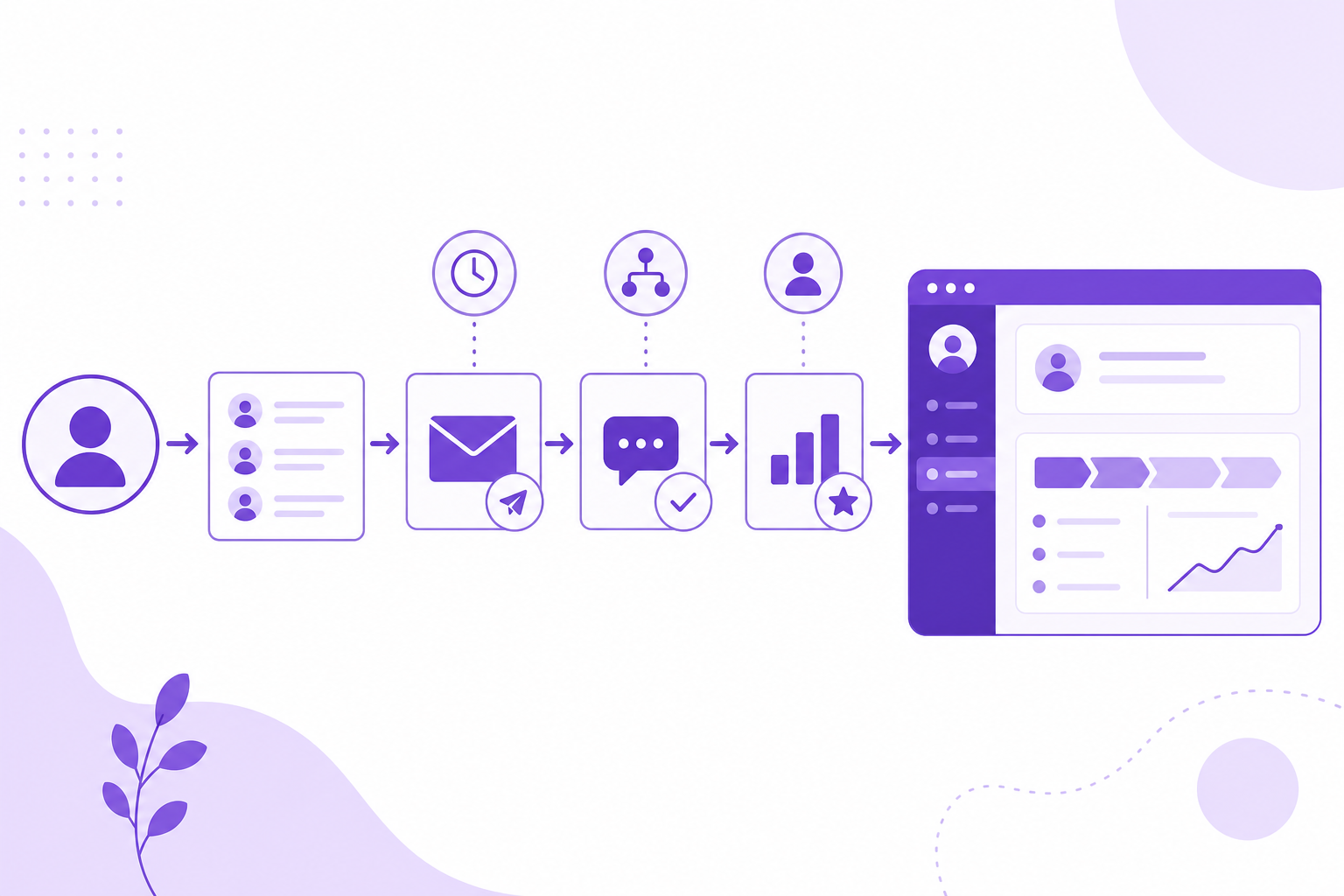
B2B sales automation uses software, AI, and structured workflows to handle repetitive sales tasks—so humans focus on strategy, relationships, and deal execution. Automatable processes include:
- Prospect discovery and list building
- Contact enrichment and decision-maker identification
- Email verification and lead scoring
- Outreach sequences and follow-up cadences
- CRM data entry and pipeline stage updates
- Meeting scheduling and calendar coordination
- Reporting and pipeline forecasting
Automation does not mean removing the human from sales. It means removing the spreadsheet from sales.
Why B2B Sales Teams Need Automation in 2026
Manual sales processes create predictable problems as teams grow:
- Inconsistent prospecting — each rep researches differently, producing uneven pipeline quality
- Follow-up gaps — busy reps forget touchpoints; deals go cold
- CRM data decay — incomplete records undermine forecasting and handoffs
- Scaling bottlenecks — adding reps does not linearly increase output when research is manual
- Activity vs outcome confusion — teams measure emails sent instead of meetings booked
Automation standardizes the repeatable work so performance depends on strategy and execution—not who spent the most hours on LinkedIn.
The B2B Sales Automation Stack
Most effective teams automate across four layers:
Layer 1: Discovery and Research
AI platforms find ICP-matched companies, identify decision-makers, and build scored prospect lists. This is the highest-ROI automation layer. Deep dive: lead research automation.
Layer 2: Verification and Enrichment
Validate emails, confirm role accuracy, and enrich firmographic data before outreach. Never automate campaigns on unverified contacts. See how to verify B2B leads before outreach.
Layer 3: Outreach and Engagement
Email sequences, LinkedIn automation, and multi-touch cadences deliver consistent follow-up without manual scheduling. Personalize at the segment level; automate the timing and delivery.
Layer 4: Pipeline and CRM Management
Automated CRM updates, stage progression rules, task creation, and pipeline reporting keep deals moving and data accurate.
Step-by-Step: Building Your Sales Automation Workflow
Follow this ten-step framework to design an end-to-end automated sales process:
Step 1: Define Your Ideal Customer Profile
Automation amplifies whatever targeting criteria you set. Document industry, company size, geography, buyer type, revenue range, and disqualifiers before selecting tools.
Step 2: Select Discovery Tools
Choose an AI prospecting platform or prospect database that matches your ICP. Compare options in AI sales prospecting tools compared.
Step 3: Configure Automated List Building
Set ICP filters, run weekly or bi-weekly discovery jobs, and generate prospect lists on a recurring schedule. Use lead research checklist for quality gates.
Step 4: Automate Contact Verification
Run every list through email validation before CRM import. Remove bounces, duplicates, and do-not-contact accounts automatically.
Step 5: Score and Segment Prospects
Apply AI or rule-based scoring to rank prospects A/B/C. Route A-tier leads to senior reps; automate nurture for B and C tiers.
Step 6: Sync to CRM
Map fields, assign ownership by territory, and create records with standardized tags. Eliminate manual copy-paste into Salesforce or HubSpot.
Step 7: Launch Outreach Sequences
Configure multi-touch email and LinkedIn cadences with personalization tokens (company name, industry, role). Standard sequence: 5–7 touches over 3–4 weeks.
Step 8: Automate Follow-Up and Task Creation
When a prospect replies or books a meeting, trigger CRM tasks, notifications, and stage updates automatically.
Step 9: Monitor and Optimize
Track reply rates, meeting conversion, and pipeline velocity by segment. Refine ICP filters and messaging based on data—not assumptions.
Step 10: Scale What Works
Replicate successful workflows to new territories, industries, or product lines. Automation makes scaling a configuration change—not a hiring spree.
What to Automate vs What to Keep Human
| Automate | Keep Human |
|---|---|
| Company discovery and list building | Strategic account selection for enterprise deals |
| Email verification and data enrichment | Highly personalized messaging for key accounts |
| Follow-up sequence timing and delivery | Objection handling and negotiation |
| CRM data entry and stage updates | Relationship building and trust development |
| Lead scoring and routing | Closing and contract discussions |
| Meeting scheduling | Discovery calls and needs assessment |
The rule: automate repetitive, rules-based tasks. Keep humans on judgment, empathy, and high-stakes conversations.
B2B Sales Automation Tools by Function
Prospecting and Discovery
AI platforms that find ICP-matched companies and decision-makers. Foundation of the automation stack. Also see sales intelligence tools.
Email Outreach and Sequences
Platforms for sending personalized email cadences, tracking opens and replies, and managing deliverability. Pair with discovery tools—outreach platforms do not find prospects.
LinkedIn Automation
Tools for connection requests, InMail sequences, and profile-based research. Use within platform limits to avoid account restrictions.
CRM and Pipeline Management
Salesforce, HubSpot, Pipedrive, and similar systems for deal tracking, activity logging, and forecasting. Automate data flow into CRM—not around it.
Conversation Intelligence
Call recording, transcription, and coaching insights. More relevant for mid-funnel optimization than top-of-funnel prospecting.
AI vs Rule-Based Sales Automation
Two automation approaches serve different needs:
- Rule-based automation — if/then workflows (e.g., "if email opened, send follow-up in 3 days"). Predictable, transparent, limited adaptability.
- AI-powered automation — machine learning for ICP matching, lead scoring, and decision-maker discovery. Handles complexity and scale that rules cannot.
Best practice: use AI for discovery and scoring; use rule-based automation for outreach timing and CRM workflows. Compare AI and manual approaches: AI prospecting vs manual prospecting.
Common B2B Sales Automation Mistakes
- Automating outreach before verifying contact quality
- Sending identical messages to every prospect segment
- Over-automating to the point buyers feel spammed
- Skipping ICP definition—automation amplifies bad targeting
- Buying tools without integrating them into a single workflow
- Measuring activity metrics (emails sent) instead of outcomes (meetings booked)
- Neglecting CRM hygiene—garbage data in, garbage forecasts out
- Automating before proving manual process works
Automate a proven process. Do not automate chaos.
Measuring Sales Automation ROI
Track these KPIs monthly:
- Research hours saved per rep
- Qualified prospects added per week
- Outreach reply rate (automated vs manual baseline)
- Meetings booked per 100 prospects
- Pipeline velocity — days from prospect to closed-won
- Cost per qualified lead
- CRM data completeness score
- Revenue per rep — ultimate productivity metric
If automation increases volume but decreases reply rates, revisit list quality and personalization—not tool selection.
Sales Automation by Team Role
SDRs and BDRs
Automate list building, verification, sequence enrollment, and CRM logging. Reps focus on reply handling, qualification calls, and meeting booking.
Account Executives
Automate account research, stakeholder mapping, and follow-up reminders. AEs focus on discovery, demos, proposals, and closing.
Sales Managers
Automate pipeline reporting, activity dashboards, and coaching triggers (e.g., deals stalled beyond X days). Managers focus on strategy, coaching, and forecast accuracy.
RevOps
Own the automation architecture: tool selection, integration, data governance, and workflow documentation. RevOps ensures automation serves the revenue engine—not the other way around.
30-Day Sales Automation Implementation Plan
- Week 1: Map current sales process; identify top three time-consuming manual tasks
- Week 2: Define ICP; select discovery and verification tools; configure first automated list
- Week 3: Integrate with CRM; build first outreach sequence; train team on workflow
- Week 4: Launch pilot with one segment; measure reply and meeting rates; iterate
Prove ROI on a single workflow before automating the entire sales organization.
Decision-Maker Discovery in Automated Workflows
Automation fails when it reaches the wrong person. Integrate decision-maker identification into your discovery layer:
- Filter contacts by title relevance to your sale
- Prioritize procurement, operations, and executive roles
- Verify role accuracy before sequence enrollment
- Map multiple stakeholders for multi-threaded enterprise deals
Read how AI finds B2B decision-makers to optimize this step.
Compliance and Ethics in Sales Automation
Automation increases reach—which increases compliance responsibility:
- Honor opt-out requests immediately across all sequences
- Comply with CAN-SPAM, GDPR, and regional email regulations
- Respect LinkedIn platform limits on connection and messaging automation
- Maintain transparent data sourcing practices
- Never misrepresent automated messages as deeply personal one-to-one outreach
Ethical automation builds pipeline sustainably. Aggressive automation burns domains, damages brand, and invites legal risk.
Frequently Asked Questions
What is B2B sales automation?
B2B sales automation uses software and AI to handle repetitive sales tasks—prospect discovery, contact verification, outreach sequences, CRM updates, and pipeline reporting—so reps focus on conversations, relationships, and closing deals.
Which sales tasks should I automate first?
Start with prospect discovery and list building—the highest-volume, lowest-judgment tasks. Add contact verification and CRM sync next. Automate outreach sequences once list quality is proven. Save deal negotiation and relationship building for humans.
Does sales automation hurt personalization?
Only if implemented poorly. Automate timing, delivery, and data gathering. Personalize messaging with company name, industry, role, and relevant value propositions. Segment sequences by buyer type for relevance at scale.
How much does B2B sales automation cost?
Stacks typically range from $200–$800 per rep per month across discovery, outreach, and CRM tools. Start with one discovery platform ($100–$300 per user) and add layers as you prove ROI. Cost per qualified lead matters more than total subscription cost.
Can small sales teams benefit from automation?
Yes—small teams often benefit most. A two-person team with automation can produce pipeline comparable to a five-person manual team. Start with AI discovery plus one outreach tool before building a full stack.
How Adsaga.ai Powers B2B Sales Automation
Adsaga.ai automates the most time-consuming step in B2B sales: finding qualified prospects with verified decision-maker contacts.
With Adsaga.ai, teams can:
- Automate ICP-matched company discovery across industries and geographies
- Identify verified procurement, operations, and executive decision-makers
- Build scored prospect lists ready for CRM import and outreach sequences
- Reduce research time from hours per rep to minutes per list
- Feed downstream automation—email, LinkedIn, CRM—with quality data
- Scale prospecting without proportionally increasing headcount
Adsaga.ai is the discovery engine for your sales automation stack. Try Adsaga.ai and build your first automated prospect list today.
Final Thoughts
B2B sales automation is not about sending more emails—it is about building a repeatable system that consistently produces qualified pipeline. The teams winning in 2026 automate discovery, verification, and follow-up while keeping humans on the conversations that close deals.
Start with one workflow. Prove it works. Then expand. Define your ICP, automate research, verify contacts, integrate with CRM, and measure meetings booked. Every layer you add should increase pipeline quality—not just activity volume.
Ready to streamline your sales process? Get started with Adsaga.ai or explore more automation guides on the Adsaga blog.